
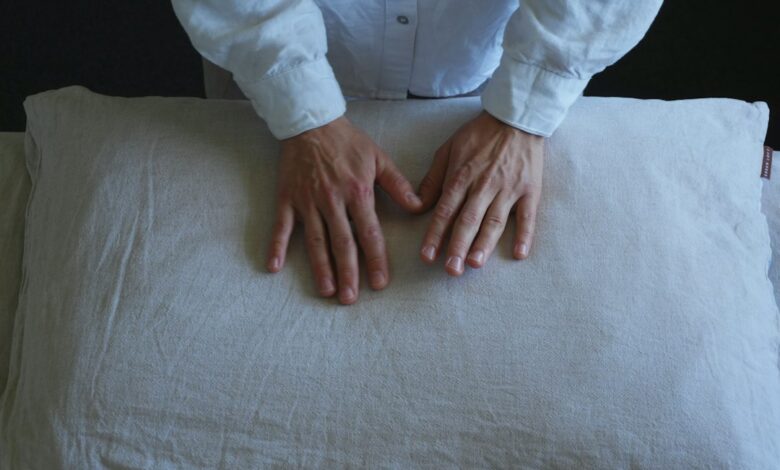
How often should you replace pillows? The usual answer is every year or two, but that’s a rule of thumb rather than a measured standard. Cleveland Clinic sleep specialist Brian Chen, MD, says most pillows “usually need to be replaced within a year or two,” and Sleep Foundation gives the same 1–2 year range. But CHOICE says it couldn’t find any scientific evidence for putting a use-by date on a pillow.
Two separate questions give you a better answer. Does the filling still spring back after you squash it? And can the pillow still be kept clean? None of this is medical advice. If you have asthma, allergies, or neck pain that won’t settle, talk to a clinician. A simple home check tells you more than the date on the label.
The Signs Your Pillow Is Past Its Prime
The signs that a pillow is past its prime fall into three groups: changes to its shape and support, hygiene problems that last through a wash, and how you feel in the morning. Shape and support are the most reliable signs. Morning neck stiffness or headaches are the least reliable, because they have other possible causes.
Structural signs point straight at the filling. Dr. Chen suggests checking whether the pillow feels lumpy or has a dent where your head lies. He explains that the material “tends to give out after a while.” CHOICE adds sagging and lost firmness, and says no amount of shaking or fluffing will fix a pillow that has gone that way. It also says that if you have to fold a flat pillow in half to get the comfort it used to give, it’s probably on its last legs. Hong Kong’s Consumer Council puts it simply: replace pillows when they become deformed.
Hygiene signs are a separate category. Good Housekeeping UK treats yellow stains and a lingering smell as signs that sweat, body oils, and moisture have built up, even with regular washing. Carolyn Forte of the Good Housekeeping Institute advises replacing a pillow that still smells funny after a good wash.
Symptoms in your body are the hardest signs to read. Dr. Chen links poor pillow support to muscle tension in the neck and shoulders and says it can even cause a headache in the morning. Good Housekeeping UK counts allergies that seem worse in bed among the signs you need a new pillow. But CHOICE points out that a sore neck can also come from poor posture, “tech neck,” or ageing. A symptom on its own doesn’t prove the pillow is to blame.
Taken together, these sources suggest the three groups don’t depend on each other. A pillow can be lumpy but clean, or still plump but sour-smelling. That matters later, because the two kinds of failure need different responses. For some owners, shape alone decides it. As one poster in r/Bedding put it, “Once a pillow gets permanently lumpy, I get a new one.”
The Fold Test: What It Measures and Where It Falls Short
The fold test is a quick home check of compression recovery, meaning how fully and how quickly a pillow’s filling returns to shape after being squashed. It suits fiber-filled pillows much better than solid foam, latex, or buckwheat. CHOICE, Good Housekeeping, and Cleveland Clinic all recommend it, but none of them cites a study showing the test is accurate.
Testing labs measure the same property more formally. The independent textile lab IDFL lists loft height (the pillow’s uncompressed height), compression and recovery, and matting and clumping among the performance tests it runs on pillows before and after laundering. A pillow fold test gives you a rough version of that result at home, with no equipment.
How to run the recovery test
The steps below combine the published fold-test methods with a simple log, so you can see decline over time instead of relying on one pass or fail.
- Step 1: Write down the baseline. Note the date, the fill type from the care label, and roughly how often the pillow has been washed. Lay it flat on a hard surface, stand a ruler upright at the center without pressing down, and write down the height. If you later buy a new pillow with the same fill, measure it the same way so you have a reference.
- Step 2: Fold and hold. CHOICE’s method is to fold the pillow in half on a flat surface, hold it down for 30 seconds to a minute, and let go.
- Step 3: Read the result. According to Good Housekeeping UK, a pillow that springs back or slowly unfolds still has some life left. One that stays folded has lost its structure and needs attention.
- Step 4: Wash and retest before you decide. For a washable pillow, the same Good Housekeeping UK guidance says to wash it following the care label, dry it thoroughly, fluff it, and fold it again. If it still stays folded, it’s done for good.
- Step 5: Log it and repeat. CHOICE recommends testing roughly every six months. Record the date, the height, and the fold result each time. A height that keeps dropping from one entry to the next shows the gradual loss a single fold can miss.
Good Housekeeping UK also describes a saddlebag variant. You drape the pillow over your arm, and if it folds over like a saddlebag, it’s past its prime. If it resists, it’s still usable.
Where the test falls short
The published versions don’t agree on timing. CHOICE holds the fold for up to a minute, while Good Housekeeping UK calls theirs a one-second test. No source shown here explains which hold time is more telling. The practical answer is to use the same method every time so your log entries can be compared.
Memory foam is the clearest exception. ASTM D3574, the standard set of test methods for polyurethane foam, includes a recovery-time test for slow-recovery memory foam, measured in seconds. Because slow recovery is something the standard measures as a designed property, a slowly unfolding memory foam pillow isn’t necessarily failing. For solid foam and latex, Dr. Chen’s dent check is a better guide than folding. Buckwheat doesn’t spring back at all. Sleep Foundation suggests replacing the hulls once they start to flatten instead.
The fold test also says nothing about cleanliness. A pillow can spring back perfectly and still carry the allergen and fungal load covered in the next section. None of the sources cited here sets a percentage of height loss that means you must replace the pillow. The log shows you the trend, and you make the call.
Why Pillows Break Down: Fill Fatigue and Hygiene
Pillows break down in two separate ways. Repeated squashing gradually wears down the filling’s ability to recover, and over time the pillow also collects dust mite allergen and fungi. The fold test picks up the first problem but not the second. That’s why judging a pillow means checking both its shape and its cleanliness.
Foam wear is the best documented. ASTM D3574’s Test I3 repeatedly pounds a foam sample with 750 N of force, for up to 80,000 cycles in one procedure. It then measures loss of thickness, loss of support at 40% IFD (indentation force deflection, a measure of foam firmness), and any visible structural breakdown. ASTM cautions that results apply under test conditions and are not necessarily the same in other environments, so lab cycles can’t be turned into years of sleep. The standard also covers polyurethane foams only.
Fiber and down fills are measured differently. For synthetic fill, IDFL’s test menu includes crimp frequency and shape (the built-in waviness of each fiber), fiber cross-section, and compression recovery. For down and feathers it includes fill power and compression recovery. For feather and down cushions, the European standard EN 13855-1 specifies a rotation test to evaluate durability. Its stated scope is back, seat, and armrest cushions, not bed pillows.
The only independent head-to-head durability data located is small. The Consumer Council tested 13 models in 2026: seven memory foam, three latex, and three polyester. The memory foam and latex models generally scored 4 points or more for durability. Two polyester models scored 3.5 and showed “more noticeable changes in firmness and height” after testing.
The table below sums up what this evidence shows about how each fill wears and how that wear gets measured.
| Fill type | What the evidence shows wearing out | How it is measured |
|---|---|---|
| Polyurethane and memory foam | Lost thickness and support, visible breakdown after repeated loading | ASTM D3574 Test I3; Test M for recovery time |
| Polyester fiber | Larger firmness and height changes in two tested models | IDFL crimp, recovery, matting and clumping |
| Feather and down | Durability judged by thickness and compressibility change | EN 13855-1 (cushions); IDFL fill power |
| Latex | Scored 4+ for durability in a three-model sample | Consumer Council lab testing |
| Buckwheat | Hulls flatten over time | Visual check; hull refresh about every 3 years |
The key point is that “wearing out” means a different physical change in each fill. A single calendar rule treats them as if they wore out the same way.
Hygiene build-up runs alongside physical wear. In a University of Manchester study of 10 used pillows aged 1.5 to more than 20 years, researchers cultured 4 to 16 fungal species per pillow. Aspergillus fumigatus was the most common, and synthetic pillows had more species. The authors concluded pillows “could be” a primary source of fungal exposure, with implications for people with asthma and sinusitis. A New Zealand study put new synthetic and feather pillows on 12 beds for a year. The synthetic pillows reached 19.28 μg/g of the dust mite allergen Der p 1, against 6.45 μg/g for feather. How much a pillow collected was strongly linked to the mattress’s starting allergen level.
These studies show that contamination builds up, and that the surrounding bed matters. Neither one sets an age at which a pillow becomes unsafe.
How Often to Replace by Fill Type
How often you should replace a pillow depends partly on which source you ask, because the published ranges by fill type disagree widely and none rests on a measured standard. Sources agree that polyester wears out fastest. For memory foam, latex, and down, their ranges differ by years. Treat any range as a reminder to test, not as a deadline.
That gap explains the question one poster put to Reddit’s r/Frugal community: “Am I being super gross for not replacing bedding this often.” The table compares two widely read answers to how long pillows last.
| Fill type | CHOICE range | Sleep Foundation range |
|---|---|---|
| Polyester | 6 months to 2 years | 6 months to 2 years |
| Memory foam | 5–10+ years | 2–3 years |
| Latex | 5–10+ years | 2–4 years |
| Feather and down | 5–10+ years | 1–3 years |
| Cotton and wool | 3–5 years | Not listed |
| Down alternative | Not listed | About 1–2 years |
Sources: CHOICE and Sleep Foundation.
The two sources agree on polyester, which fits the Consumer Council’s polyester durability results. For foam, latex, and down, one source’s upper limit can be several years past the other’s. On this evidence, those ranges are too far apart to settle the question for a pillow that still recovers well. Use-by dates are no firmer. CHOICE reports that pillow maker Tontine began printing two-year use-by dates in 2010. CHOICE says neither Tontine nor any other source it found had evidence for a use-by date. The company that owns Tontine told CHOICE its consumer research suggested people kept pillows for about seven years.
A check-and-replace schedule by fill type
The schedule below is a practical summary built from the sources above. The six-month check is CHOICE’s suggestion, and each replacement trigger comes from the linked guidance.
| Fill type | Check | Replace when |
|---|---|---|
| Polyester and down alternative | Recovery test every 6 months | Still stays folded after washing and full drying (GH UK) |
| Feather and down | Recovery test every 6 months | Won’t spring back when folded (Sleep Foundation), even after a wash |
| Memory foam, polyfoam, solid latex | Inspect every 6 months; skip folding | Permanent dent or deformed shape (Consumer Council) |
| Buckwheat | Check hull height | Refresh the hulls once they flatten, about every 3 years |
| Any fill | Smell after washing | Odor survives a good wash (GH US) |
In practice, a pillow that keeps passing its checks has no evidence-based expiry date. One that fails on shape, or on a smell that won’t wash out, is due for replacement whatever its age.
When hygiene alone isn’t a reason to replace
For people allergic to dust mites, hygiene can often be managed instead of solved by buying new. The AAAAI/ACAAI practice parameter on dust mites (US clinical guidance from 2013) states that existing pillows “can be kept if they are encased in allergen-impermeable covers,” and it strongly recommends pillow encasings. The same document warns that covers alone are unlikely to bring clinical benefit unless they’re part of a broader avoidance plan. The 2020 NAEPP asthma update conditionally recommends impermeable covers only as part of a multicomponent plan for people with asthma who are sensitized to mites. A Cochrane review of 55 trials found no effect of mite-control measures on asthma outcomes. Encasing an old pillow is therefore a reasonable alternative to replacing it for mite allergen, but neither option promises relief from symptoms.
Care Habits That Extend Pillow Life
Care habits that extend pillow life do two things. They keep sweat, oils, and allergen away from the filling, and they avoid damaging the filling while you clean it. Washing can bring back some bounce in washable fiber and down pillows. It can’t rescue a filling that has stopped recovering, and it can ruin solid foam.
Start with the care label. Forte recommends following it, using liners or protectors under pillowcases to help a pillow last longer, washing pillowcases every one to two weeks and liners about every other month, and washing the pillows themselves every three to six months. Sleep Foundation is stricter on pillowcases and says to wash them at least once a week.
How you wash depends on the fill:
- Down and fiberfill: Forte’s method is a gentle cycle in warm water with a small amount of detergent and an extra cold rinse, then tumble drying on low with dryer balls, stopping to fluff and break up lumps. Good Housekeeping UK stresses drying thoroughly before you retest.
- Solid memory foam and latex: these shouldn’t go in the washing machine. Vacuum them, spot clean gently because wet foam tears easily, and let them air dry completely. Sleep Foundation adds that latex shouldn’t be soaked or wrung.
- Buckwheat: moisture can ruin it, so Sleep Foundation suggests a removable, washable cover and drying the hulls in the sun after a spill.
For dust mites, how often you wash matters more than how hot the water is. The AAAAI/ACAAI parameter advises washing bedding weekly and says high temperature isn’t necessary. It recommends keeping home hot water below 120°F because hotter water is a scalding risk. It also recommends keeping indoor relative humidity at 35% to 50% to limit mite growth.
Know when the pillow isn’t the problem. Dr. Chen advises seeing your physician if discomfort continues after you get a new pillow, because another issue may need attention. The Consumer Council gives the same advice for neck and shoulder discomfort that doesn’t improve. If night-time allergy symptoms continue despite encasing and washing, ask a clinician about testing. The same practice parameter recommends skin prick or blood tests for people with suspected dust mite allergy.
The Check That Changes the Decision
No evidence-based calendar decides when a pillow is finished. Its recovery and its cleanliness do. Run the fold test, or the dent check for foam, every six months, and wash and fully dry washable pillows before you judge them. If a pillow still recovers and has no smell after washing, you can keep it. If it fails either check, replace it, whatever the date on the label says.
Frequently Asked Questions
Does a more expensive pillow last longer?
Not necessarily. Sleep Foundation says higher-quality materials generally mean replacing a pillow less often. In the Consumer Council’s small test, fill type made the clearer difference to durability. Dr. Chen stresses fit over price.
Is it unhygienic to keep a pillow for ten years or more?
Old pillows do build up fungi. The Manchester study found 4 to 16 species in each used pillow it examined, some older than 20 years. It didn’t set a safe age limit, and AAAAI/ACAAI guidance allows encased pillows to be kept.
Do pillowcases need replacing too?
Yes, eventually. Sleep Foundation suggests washing pillowcases at least weekly and replacing them every one to two years, following each fabric’s care label.
Is any pillow protector an allergen-impermeable encasing?
Not necessarily. The AAAAI/ACAAI parameter says woven microfiber encasings with a mean pore size under 10 microns can block the main dust mite allergen. It advises against nonwoven encasings because they can’t be washed and allergen builds up in them.
