
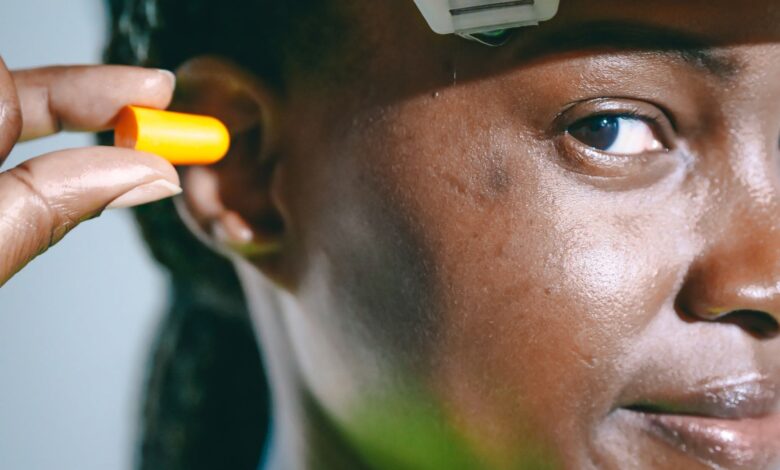
Finding a solution for sleeping in a noisy apartment can be a little dull, as the most reliable solutions require the act of closing off the air ways that noise travels through, as well as wearing a good set of custom-made earplugs. Other items like foam panels or a soothing sound machine may not be supported through research studies but are just added bonuses. In fact, the World Health Organisation guidelines on Community Noise state that just a few occurrences, or peaks of loud noise can affect an individual’s sleep even if there are minimal amounts of noise throughout the night.
Two additional factors complicate the plan. First, research on masking noise as a sleep aid are generally rated as having low quality. Second, a 2026 study from a sleep lab trial indicated that constant “pink noise” had a negative impact on a person’s amount of time spent in a REM sleep state. Additionally, the constant rumbling coming from below might create an entirely different type of sound problem than that coming from other areas of the building; so it is always best to figure out how your noise problem matches with your noise source before spending your money on solutions.
This article is intended solely as a general guide for dealing with noisy environments and sleeping. It is not to be construed as medical or legal advice, nor is it a substitute for discussion with an appropriate expert in dealing with sleep-related issues caused by noisy environments.
Start by Identifying What Kind of Noise You’re Dealing With
Every noise-related issue in a building comes down to the same question according to Commercial Acoustics (CA): is the sound an airborne or structure-borne noise? Airborne noise consists of sounds that are transmitted through the air and escapes through holes, thin walls, and windows. Examples of airborne noise are people’s voices, television, dogs barking, and traffic. Structure Borne Noise is transmitted via the building’s structural components; e.g., Floors, Beams, & Wood Stud Wall Assemblies. Structure borne noise includes footsteps, washing machines, pumps, and train or heavy truck ground rumblings. According to CA, once vibration is present in the building’s structure, it can be transmitted to several other rooms, making it much more challenging to isolate.
The second consideration for noise problems is timing. A continuous sound from a fan or air conditioner is different from a door that slams two times a night. WHO’s 1999 guidelines categorizes these two types of sounds separately. Guidelines for continuous sounds are based on the average level of sound, while guidelines for single, intermittent sounds are based on a maximum level of sound; thus, it is possible for both types of sounds to have the same average level but have very different nights of sleep, identical averages can hide very different nights.
A quick test helps. If you can hear it, it is probably airborne. If you can feel it, in the mattress, the floor, or your pillow, structure is carrying at least part of it. One renter in Zurich described feeling “the vibrations in my pillow” from footsteps and bangs. A Portland renter living beside a streetcar line wrote that earplugs and white noise did not work for sleeping against a bass-like rumble they could feel through the floor. These are individual accounts, not data, but they show what the felt category is like to live with.
| Noise type | Typical examples | How it reaches you | What tends to help | What won’t fix it |
|---|---|---|---|---|
| Airborne, intermittent | Voices, phone calls, door slams, sirens | Gaps around doors and windows, thin partitions | Sealing gaps, earplugs | Foam panels, rugs |
| Airborne, steady | Neighbor’s TV hum, distant traffic | Same air paths | Sealing gaps; masking for some people | Panels used as “soundproofing” |
| Structure-borne impact | Footsteps, dropped objects, furniture | Floors, slabs, framing | Fixes at the source (underlayments upstairs), landlord action | Sealing your own door gaps |
| Low-frequency rumble | Bass music, streetcars, heavy trucks, building machinery | Structure and air | Building-level isolation; escalation | Earplugs alone, ratings based on speech frequencies |
Handling low-frequency noise differently is necessary. The World Health Organization (WHO) says that when noise contains a large share of low frequencies, still lower guideline values are needed and A-weighted readings can understate the problem. It also offers a rough check: if the C-weighted reading is more than 10 dB above the A-weighted one, low frequencies are likely present. The NIOSH Sound Level Meter app shows both weightings, so you can try that comparison yourself as a rough clue, not a diagnosis.
Why Noise Wakes You Up (Even When You Don’t Remember It)
Arousal refers to the temporary movement towards a lighter state of sleep or waking and is usually not remembered the next day. The presence of noise in your sleep environment does not directly correlate with waking you completely; rather the presence of noise impacts your ability to achieve restorative sleep (as mentioned above). The first stage of sleep interruption from occurring due to noise lasts until the sound level of background noise in your environment reaches approximately 30-35 decibels, according to a polysomnography study published by the journal Sleep (2026). Polysomnography, which is a form of overnight monitoring of individuals while they are sleeping, revealed that 25 healthy participants were exposed to 93 traffic-related sounds per night. Compared to nights without any noise, the presence of these sounds reduced N3 (the deepest phase of sleep) for approximately 23 minutes. This finding complements an earlier finding (WHO) which states that prolonged exposure to noise disrupts the rhythm of the various stages of sleep, especially by reducing REM.
In addition to no difference observed the following morning in the cognitive testing of study participants, none of the participants exhibited any change in either their blood pressures or hearing after only 7 consecutive days of intermittent noise exposure, but all participants reported decreased sleep quality, decreased alertness, and decreased mood/well-being after all 7 days of intermittent noise exposure. These findings will serve to help future studies understand the emotional change of individuals as a result of the structure of their sleep after only 7 days of exposure to intermittent noise and to assess the change in the structure of their sleep.
Finally, as we noted, WHO provides the following explanation as to why a door slam is much more readily perceived by humans than does the sound of a fan. Essentially, the human senses have the ability to habituate to a continuous stimulus (i.e. the fan), while the perception of any new, unanticipated sounds (i.e. the door slam) is indicative of a warning signal. These guidelines also note that the amount of disturbance to sleep that is caused by an intermittent noise event is based largely on the peaks of that event; thus, the primary focus of the remainder of the guidelines will be on addressing the peaks associated with intermittent sounds.
Even before an event occurs, the unpredictability of it is stressful to many people. As one tenant stated about their downstairs neighbor who takes loud phone calls at night between the hours of 3 and 7 a.m., “There is no way of knowing when he is going to be doing that. I start to feel anxious about it as I lay in bed at night. I never know when there going to happen. So the anxiety has kicked in every night when I go to bed.” Another commenter in the Zurich forum expressed similar feelings of anticipatory stress simply from thinking about going home. These comments are subjective observations of individual experiences rather than formally measured. However, they do suggest there is value in reducing the amount of time during which loud peaks are allowed, even if the overall noise level does not change significantly.
How Much Noise Is Too Much? What the Guidelines Actually Say
The terms are defined using three main terms: dB(A), which denotes the way that human hearing reacts to sound; LAeq, which denotes an average level for a specified amount of time; and LAmax, which denotes the strongest single point on a time graph. All of the WHO’s recommendations are based on these three metrics.
| Guideline | Where it applies | Metric | Value |
|---|---|---|---|
| WHO Guidelines for Community Noise (1999) | Inside the bedroom, continuous noise | LAeq over 8 hours | 30 dB |
| Same document | Inside the bedroom, single events | LAmax (meter set to “fast”) | 45 dB |
| Same document | Outside the bedroom façade, window open | LAeq / LAmax | 45 dB / 60 dB |
| WHO night noise guidelines, as summarized by WHO Europe | Outside the bedroom, annual average | Lnight | 40 dB(A) |
In Europe, WHO’s guideline states that in order to obtain quality sleep, bedroom noise levels should not exceed under 30 dB(A) in bedrooms at night for good-quality sleep. The recommendation from 1999 includes limiting the number of individual events to more than 45 dB LAmax, and sensitive individuals may need to aim at lower limits if there is already a low level of background noise. When the window is slightly open, the FAA figures suggest a reduction of approximately 15 dB (A).
While WHO’s recommendations are aimed at safeguarding the population as a whole, a mobile device with an average reading of 33 dB does not mean the user is in danger. It is also possible for a bedroom to have an average reading of 28 dB, but experience high levels of noise from something, like slamming doors. The 30 dB guideline is an average that can be found at home, and it is not an official reading of the app’s capabilities; instead, the target is intended to provide guidance on where to strive for an average reading of at least 30 dB.
Sealing Gaps: The Highest-Impact Low-Cost Fix
With respect to airborne noise, sound isolation is determined by the weakest point within the wall itself. According to acoustics engineer John H. Brandt, even if the sound-isolating qualities of the remainder of the wall are excellent (e.g., 60dB), an opening of 0.1 percent of a wall’s overall area reduces that wall’s effectiveness to around 30dB. Likewise, a percent (1%) opening reduces the effectiveness to around 20dB. In Brandt’s example, the rating of a door (30dB) that occupies 20% of a wall rated as 60dB causes the overall wall rating to drop to approximately 37dB. Brandt concludes that most of the airborne sound leaks through gaps and cracks can be fixed by expense, and should be addressed as a priority.
The vendor Acoustical Solutions states similarly, a gap around a door that is 1% can cut its sound blocking by up to 50%. Take this statement for what it is (a marketing claim), while Brandt’s calculation provides a more rigorous approach to the same concept.
In the real world, you should start fixing gaps and cracks with the gap at the bottom of the bedroom door, then work on the sides and the top of the door where it meets the frame. Brandt recommends that a door that is hinged with seals around all four sides (including the threshold) will create a positive seal against the frame when closed. If there is no seal at the bottom of the door, you should install a drop seal. After completing the bedroom door, the next place to check for gaps and cracks should be the windows; ensure that the windows are both completely closed, and check the weather stripping surrounding the window. Before recommending that you wear ear plugs while sleeping, the same sleep-medicine nurse practitioner quoted by the UW Medicine advises that you should ensure your windows and doors are closed and that any gaps or cracks have been sealed before needing to use ear plugs while sleeping.
There are Trade-Offs. According to the authors of the SLEEP study, the sound insulation benefits of closing windows [while windows stay closed, which can hurt bedroom air quality] will negatively impact air quality in the bedroom. In addition, Brandt considers ventilating indoor spaces with healthy indoor air to be vital and cites the fact that most municipal building codes require proper airflow. It is advised to seal leaks, not vents. Renter’s who wish to install a doorstop or a door sweep should always check with their landlord or property’s governing documents prior to attaching anything to a door frame or entry point.
It is also essential to understand the limitations. The study supporting the construction of consumer door sweeps and door stoppers did not gather independent before-and-after research results; therefore there is no way that they may guarantee you will achieve any specific measurement after installation. Also, sealing the area around your doors does not eliminate the potential for vibration transmitted through the wall into the surrounding area.
Earplugs: The Most Evidence-Backed Fix for Most People
Earplugs are the only product in this review that have a sleep-lab study to support their use for stopping unwanted sounds (noise) on your sleeping ability. In a 2026 randomized crossover design study, earplugs significantly reduced the adverse effects of noise during sleep and increased both the number of minutes spent in deep sleep and/or REM sleep by an average of 21 minutes compared to nights where the participants were exposed to noise and not using earplugs. One limitation to this study is that earplugs did not reduce the noise exposure of participants at the loudest sounds they were exposed to (65 dbA). Participants in the study were 25 (healthy) adults that were 21-41 years old. Furthermore, other research regarding the effectiveness of earplugs used in hospitals has produced mixed results.
Fit decides how well they work. When the researchers measured each person’s actual reduction, it averaged 25.5 dB but ranged from 10.8 to 41.6 dB. The rating printed on the box, the NRR (Noise Reduction Rating), is a lab figure. NIOSH warns that it often does not reflect the protection a given wearer actually gets. Good Housekeeping’s Tech Lab tested 16 sleep earplugs on an acoustic test rig and measured reductions of 13.5 to 20.4 dB for products labeled NRR 24 to 33. In those tests, disposable foam plugs reduced sound more than reusable ones. NIOSH suggests a simple fit check: count out loud while slowly cupping and uncupping your hands over your ears. If your voice sounds about the same either way, the fit is probably good.
UW Medicine has clearly outlined the risks associated with using earplugs nightly: earwax pushed back into the canal, bacterial or fungal infection, eardrum damage from forcing in plugs that are too big, and sleeping through alarms. The N.P. who provided the interview quoted by UW Medicine goes on to say that silicone is likely the safest material for overnight use, while foam actually offers the most noise reduction. This creates a real dilemma between cleanliness and noise reduction. If you experience any of the following symptoms, you should discontinue using earplugs: pain in your ears, redness, itching, use of a liquid medium, or intermittent hearing.
Typically, cost is not a deterrent to the use of disposable foam earplugs. An example would be one bulk package containing 200 pairs for under $30 of disposable foam earplugs for less than $30 through Good Housekeeping. Therefore, disposable foam earplugs cost less than 15 cents per pair.
Active noise-cancelling earbuds are in a separate category. NIOSH has warned that products that use active noise cancelling technology should not be considered hearing protection unless the product carries an NRR rating. There were no comparisons on the effectiveness of earbuds compared to earplugs based on studies in sleep laboratories referenced in this document.
White Noise and Masking: Useful for Some, Not a Cure-All
Masking is a technique for manipulating background noise so that undesirable noises will have a reduced impact on sleep quality. It has gained popularity in recent times, but there isn’t much conclusive research supporting its effectiveness. A systematic review conducted in 2021 of 38 different studies demonstrated that there is very little to no evidence supporting the use of continuous noise to improve sleep quality. The systematic review also warned that such techniques might actually be detrimental to both sleep and hearing. Overall, the systematic review was unable to reach a clear conclusion regarding the relationship between white noise and sleep as there were as many studies that showed positive results as there were those that reported negative findings. Harvard Health sums up the results on white noise for sleeping as mixed.
The 2026 trial made the concern sharper. Pink noise at 50 dB, on its own, cut REM sleep by about 18.6 minutes compared with a quiet night. Adding pink noise to intermittent noise did not significantly improve deep and REM sleep compared with the noise alone. Penn Medicine’s summary adds that on nights combining both, time awake ran about 15 minutes longer. A smaller study points the other way. In a 2026 pilot with 12 healthy adults, continuous pink noise at 45 dB reduced the sleep fragmentation caused by traffic noise. Those authors say their result should be read cautiously. So the evidence currently conflicts, possibly depending on volume and study design, and it doesn’t support treating masking as a reliable fix.
For someone who can’t wear earplugs, masking may still be beneficial. According to Dr. Sogol Javaheri of Harvard Health, if you are using a white noise machine, place it in the corner of the room, turn the volume no higher than a background conversation, and set a timer to turn off after you fall asleep. She does not suggest using pink or brown noise all night long. There is an additional disadvantage pointed out by the authors of SLEEP: masking may cover up necessary sounds like a smoke alarm or a crying baby.
Masking has limits to help with intermittent voices as well. The person renting an apartment who received late-night phone calls at 3:00 a.m., ran fans, couldn’t wear earplugs, and was still being woken, faced these same issues. While this is just one person’s experience, it illustrates this limitation.
Surface Treatments: What Curtains and Rugs Actually Do
The characteristics of soft surfaces are that they have the ability to absorb sound, but do not prevent it from traveling through an area (for example: between two separate rooms). Commercial Acoustics suggests that with the help of absorptive finishes such as wall panels and carpets, you can control reflections and reverberant buildup inside a room, and reduce the amount of sound that can bounce off the walls and build up in that space. To block sound between different rooms, you need to have enough mass or airtight seals in place. Resonics, a company that provides acoustic treatment products, states that reducing the echo in a room will reduce the perception of the sound being as intrusive, “but the sound is still there.”
Curtains function as both sound absorption and sound blockage. In the information provided for this research, we did not find a measurement of “soundproofing” for curtains placed over real apartment windows. However, based on the calculations of gaps noted in the previous section, you could assume that a heavier type of curtain hung tightly over a leaky window may provide some blockage of air flow between the window and the room. The extent of this block will depend on the type of window. One Portland resident suggested a very simple test that can be done before purchasing a curtain. He recommends hanging an area rug or thick blanket over the window and listening to how much the noise coming into the apartment has decreased.
Rugs function most effectively where the sound originates. For example, Commercial Acoustics states that footfall complaints from residents in an apartment building were resolved by placing a resilient underlayment beneath the floating floor. This was a treatment that was used on the floor where the footfalls originated. Thus, when you place a rug on the floor of your apartment, it helps to muffle your footfalls for the resident who lives below you. However, it is not a proven method for muffling footfalls of residents who live above you.
When the Problem Is Vibration, Not Just Noise
Structure-borne noise calls for a different approach: stop vibration at the source with resilient connections, floating floors, and spring or neoprene mounts under machinery. Those are building-level fixes, not things a renter can add.
According to Brandt’s engineering analysis, low-frequency noise cannot be easily treated with inexpensive methods. The STC rating measures airborne sound attenuation of walls but does not address any frequencies below 125 Hz, [ignores everything below 125 Hz]. A double-stud wall rated STC 69 had only about 27 to 32 dB attenuation at 50 to 63 Hz. Brandt also indicates that a floated element will begin to isolate above approximately 1.4 times its natural frequency. This analysis does not include the use of bed pads, but would indicate that using just a strip of rubber material under each bed leg may not prevent low-frequency rumble, depending on the stiffness of the pad and the frequency of the noise.
Rubber pads are still of value to renters. One renter included rubber pads under the feet of their bed in a discussion about how they were able to deal with low-frequency noise. Another suggestion in the same discussion was that a seasonal rumble might come from heating pipes or heat pumps. Producing pad materials is inexpensive, and for renters, an alternative way of addressing low-frequency problems is to move their bed from a party-wall or machine room. If the source of the low-frequency noise is building machinery, the only way to stop it is for the owner/landlord to install the necessary isolation.
Which Popular Fixes Are Actually Hype
Acoustic foam panels are the main product to use for soundproofing and two vendors of these products have made unsupported claims to the contrary. Acoustical Solutions states that the foam “does not block sound from outside or from a neighbour.” Resonics contends that if a neighbour’s bass is audible through a party wall, “nothing surface-mounted will fix it,” so the same conclusion was reached by a Portland poster in layman’s terms — basically that panels just control echo and reverberation but weren’t designed to isolate sound.
The misconception of the search term “Cheap Soundproof Bedroom” is created by an inaccurate concept. Resonics says real sound isolation occurs as a result of adding mass or decoupling the walls, ceilings or floors and therefore it should occur during construction or a major remodel of the room. The term “Renter-Grade” refers to the types of products on the market that can be used to reduce sound leaks and peaks. They are not intended to completely block out all sounds in the room.
Two additional items need critical evaluation. What is reported as NRR in the boxes is a laboratory reading, and is not a guarantee of performance in home settings. Likewise, a sound machine that operates all night long does not possess proven clinical efficacy, given the very-low-quality evidence base supporting it, along with the information from the previous discussion concerning the effects of sleep patterns on sound waves, and thus, the relevance of an all-night sound machine. Curtains that say “soundproof” are the same product as described above for purposes of sound isolation. They might assist with sound entering through a poorly sealed window; however, independent data does not indicate that they prevent incoming sound waves from penetrating through a neighbour’s house.
Cost vs. Impact: A Prioritised Spending Guide
No verified consumer data gives a cost per decibel for these fixes. The table below is a qualitative ranking built from the mechanisms and evidence above, not measured results. Real-world gains will vary with your building.
| Step | Noise it targets | Cost band | Evidence behind it | Main limit |
|---|---|---|---|---|
| Close windows, choose the quietest room, move the bed off shared walls | Airborne and structure-borne | Free | WHO lists a quiet side of the dwelling among its interventions | Closed windows affect ventilation |
| Seal door and window gaps | Airborne | Low | Engineering calculation on how much gaps limit isolation | No independent consumer before/after data |
| Fitted earplugs | Airborne, intermittent | Low | Randomized sleep-lab trial | Started failing at 65 dBA events; hygiene and alarm risks |
| Masking at low volume, on a timer | Steady airborne; maybe peaks | Low to moderate | Very low quality, and recent studies conflict | REM reduction seen at 50 dB; can hide alarms |
| Rugs, heavy curtains | Echo; possibly window leaks | Moderate | Mechanism only | Absorption is not isolation |
| Isolation pads under bed legs | Structure-borne | Low | Unknown | May not work at low frequencies |
| Building-level isolation, landlord action | Structure-borne, low-frequency | Landlord or contractor | Engineering practice | Usually out of a renter’s control |
| Foam panels sold as soundproofing | Nothing between rooms | Moderate | Vendors say they don’t block sound | Echo control only |
Noise-source diagnosis and fix-priority checklist
- [ ] Note when the noise happens, how long it lasts, and whether it is steady or comes in bursts.
- [ ] Decide whether you hear it, feel it, or both. Felt noise points to structure-borne transmission.
- [ ] Take an indicative A-weighted and C-weighted reading. A gap of more than 10 dB hints at low-frequency content, per WHO’s rough rule.
- [ ] Walk the bedroom with the noise playing and listen at the door bottom, the frame edges, the window seams, and any wall penetrations.
- [ ] Do the free steps first: close windows, choose the quietest room, move the bed.
- [ ] Seal the air leaks you found, without blocking vents.
- [ ] Try properly fitted earplugs for several nights, and test that you can still hear your alarm.
- [ ] Add low-volume masking on a timer only if earplugs aren’t an option or noise still gets through.
- [ ] If the noise is felt rather than heard, go to the vibration steps and the landlord rather than buying surface products.
- [ ] Re-measure using the same method, and keep a simple sleep diary.
How to Check Whether a Fix Is Actually Working
Your phone will indicate the change in noise level, but cannot provide a certification of a peaceful room. On iOS, NIOSH Sound Level Meter app is rated within the range of 2 dBA (accuracy), and reports average/maximum sound levels using A, C, and Z weighting. NIOSH reports that we cannot verify their Android application accuracy. An independent study published in JMIR mHealth and uHealth conducted in 2023, found that an app could be as close to 0.5 dB(A) from a real professional sound meter. The authors determined that testing an iPhone without calibrated phone mic, was done in the range of ~40 to ~85 dB. The authors concluded that a sound level meter app should complement/augment actual sound level meters and that sound level app readings that are very near (and much lower) the WHO’s recommended level of noise (30 dB) will be out of that tested range.
A simple, repeatable protocol makes before-and-after readings more meaningful:
- Use the same phone and app every time, and set it to A-weighting.
- Put the phone in the same spot each time: on the mattress at head height, or a fixed 1 m (3.3 ft) from the door you’re treating.
- Measure at the same time of night, while the noise you’re targeting is present.
- Take several readings of at least a few minutes each, and note both the average and the loudest moment.
- Repeat the same steps after the fix, and compare the change rather than the absolute number.
The readings obtained from the NIOSH Sound Level Meter (App) should only be used as indicative of your own sound level. In addition, your personal experience may also provide valuable evidence regarding your sound levels. For example, some renters reported that while their phones barely picked up bass they could clearly hear, they were able to hear considerable low frequencies through their personal auditory systems. Thus, a note regarding your mornings, wake times, and how well rested you are will provide further information on your sound levels (and may confirm readings obtained with your phone’s microphone).
When to Stop DIY and Escalate
In cases where the source of the problem is someone else’s behavior, the structure of your apartment building, or your own health, you may need to escalate your complaint. For example, if your neighbor is creating excessive noise during sleeping hours, or if there is an ongoing issue with vibration caused by machinery within the building, or if you are disturbed by noise coming from apartments above you (e.g., footsteps, dropping objects, etc.), there is nothing you can do to fix these issues from your side of the wall. A polite conversation is usually the first step in addressing these types of issues. As stated in the discussions regarding how to deal with noisy neighbors in Zurich, one participant stated that calmly addressing the situation through a daytime conversation [eventually helped but took two or three attempts] was effective after two or three attempts. If that fails, a written complaint to the landlord may be the next step.
Formal procedures depend on the area in question. For example, if you live in New York City, the 311 resource will refer you to your tenant association, building owner, or super for ongoing noise problems. If you call the police regarding ongoing noise from your neighbor, they must respond within 8 hours of the time you report the noise unless they are working on another emergency call and can only act if the noise continues at the time of their arrival. If you are living in England, it is the responsibility of the local council to investigate any noise you have reported as having the potential to become a statutory nuisance. Most local councils have a procedure for issuing warning notices about noise occurring between the hours of 11 p.m. and 7 a.m. if the level of noise exceeds a permitted limit (i.e., 34 dBA for underlying levels of 24 dBA or less, or otherwise 10 dBA above the underlying level). The level should be measured from inside the complainant’s home.
Chronic Insomnia is also something that should be addressed for health reasons: The National Heart Lung and Blood Institute define chronic insomnia as having difficulty sleeping on three or more nights a week for more than three months, and note a cognitive behavioral therapy (CBT-I) as one of the treatments that your healthcare provider may offer. If you’ve had similar sleep patterns after resolving your noise disruptions, you should visit a healthcare professional to discuss CBT-I.
The Last Check
Refer back to your initial findings. If there is a problem with airborne sound, or if the sound peaks and there are gaps that can be sealed and earplugs can fit snug between your ears and the surrounding environment, these should give you the majority of the improvement possible. If the sound is perceived through the body instead of through the ears, no matter how many additional products are installed on the other side of the wall, it is unlikely to resolve the issue. Your best options in this case are to contact your landlord or to move. Regardless of the solution you decide on, there is something you should do prior to depending on that solution: use your earplugs and any masking devices that are available, and activate your phone alarm and press the “test” button on the smoke detector. Ensure that you can still wake up.
FAQ
Will I still hear a smoke alarm with earplugs or white noise?
Possibly not, and that’s the main safety trade-off. UW Medicine lists sleeping through phone and smoke alarms as a real risk of earplugs, especially for people who live alone. A sleep physician interviewed by Good Housekeeping recommends listening to your alarm while wearing earplugs before you fall asleep. Masking can also cover warning sounds, a concern the SLEEP trial authors raise directly.
Is pink, brown, or white noise better, and does a fan count?
No evidence was found on the effectiveness of the various types of colored noise. Penn’s researchers combined white, pink, brown noise, fans and air conditioners, as broadband sound. In a study conducted by Penn’s researchers, pink noise at 50 dB (decibels) was found to significantly decrease the amount of REM sleep. In comparison, a smaller pilot study found that pink noise at 45 dB significantly reduced traffic noise fragmentation. Researchers did not find any head to head evidence on the effectiveness of brown noise in the studies that were included in this analysis. If you choose to use any of these sounds, it is best to keep the volume low and set a timer for the amount of time you want to sleep.
Is there a legal decibel limit for neighbor noise?
The answer is that it depends on where you live, as England has set a maximum permitted night noise level for council warning notices of 34 dBA in quiet environments as measured inside the complainant’s home. However, many areas use nuisance or quiet hour notices rather than a strict maximum. Your phone may record your own noise levels for your own personal record, but they should not be considered an official measure.
Can noise-cancelling headphones replace earplugs?
“”” There is no solid evidence either for or against active noise cancellation. According to NIOSH, when using active noise cancellation it is essential for users to have this feature that includes an NRR (Noise Reduction Rating) and isn’t hearing protection unless it carries an NRR. In this review, no sleep-laboratory trials comparing active noise cancellation to traditional methods were found, while comfort, safety for side-sleepers, and ability to hear alarms are some of the practical issues to be considered. “””
