
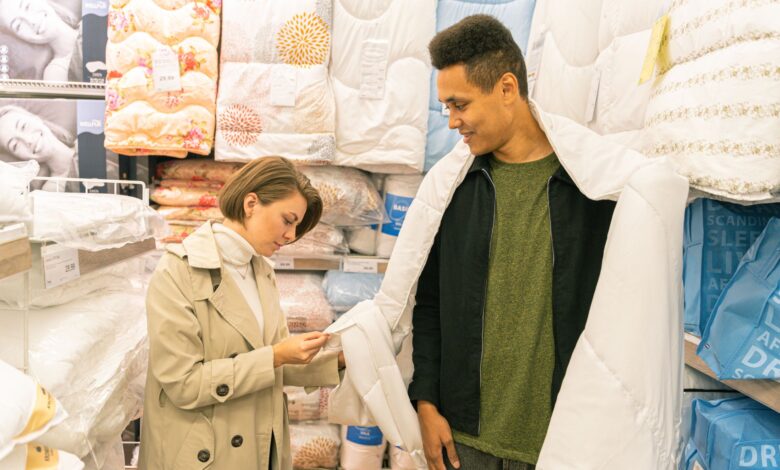
When comparing down vs. down alternative comforters, the number on the listing may not indicate the warmth of the product accurately. On the other hand, while down gives a greater amount of warmth for less weight, synthetic products (down alternatives) are less expensive and easier to maintain. Because neither product’s advantages can be summarized easily with one number alone, fill power is actually a measurement of how much space an ounce of down occupies in a controlled environment (a laboratory’s cylinder). The down-testing laboratory (IDFL) measures how much down is inside each comforter by multiplying the total weight of down by its fill power. Then they divide that value by the area of the respective comforter’s fabric using the warmth-factor formula.
As a result, two comforters may have very similar fill power ratings but differ significantly in terms of how warm they will feel, with one providing over double the warmth of the other. Since there is no equivalent test for warmth with regards to synthetic down alternatives, the two cannot be compared against one another on the same level. The construction of the comforters is what determines how properly the insulation within the comforter remains in the areas where the body requires them to be. To fairly compare both products, you must begin with an understanding of what exactly has been added to each type of comforter.
Down and Down Alternative: What Each Fill Actually Is
Down is the soft undercoating of waterfowl, made of fibers that branch out from a central point. In the trade, a “down cluster” covers down, nestling down, and plumules. A feather has a stiff quill. Parachute points to that difference as the quick way to tell down fill from feather fill: a down pillow has no hard quill shafts poking through.
What “down” means on a label
When looking for a comforter labeled as “down,” keep in mind that not every down comforter is comprised exclusively of down feathers. To be considered a “down” product according to US standards, the down component of the comforter’s filling must account for at least 75% down clusters (i.e., down cluster and no less); there can be no variance from this guideline. It is also mandatory for the comforter to display on its label a sub-label indicating the actual minimum percentage of down and to separately display any percentage of down or feather fill above 10%. In Europe, EN 12934 permits a broader range of down percentages for selling purposes; therefore, products may be labeled as “down” from 60% down, if an additional label provides actual content. According to Jack Sukalac, an engineer within the down-comforter industry interviewed by Wirecutter, any remaining percentage can be cheap feathers; thus, in lower-cost, lower-fill-power comforters, you will often find mixtures that include lower-quality down and feather fibers. Consequently, the sub-labels provide you with far more information than simply seeing the term “down” on the exterior packaging of the comforter.
Goose down vs duck down
The IDFL comparative website provides answers to this inquiry by showing that for each percentage cluster of down, goose down has a greater fill power rating than duck down, generally tests higher in fill power. Since goose down clusters are larger and originate from older geese, it is expected to have a greater fill power rating than duck down, which has an increased likelihood of having an odor. However, the same IDFL comparison sheet also states that “Some exceptional duck down can rival mediocre goose down”, which was also confirmed by Wirecutter’s test group. Wirecutter also indicated that there likely would be little to no noticeable difference in the down products produced from either the goose or duck down, probably wouldn’t notice much difference, and the two of their down recommended products used duck down. Therefore, the name of a species used for down cannot be used as a standard for evaluating the overall quality of a down product.
What a down alternative comforter contains
“Down alternative” is a catchall term for all filling types that are NOT down. At its lowest end, it’s the equivalent to polyester-cotton batting and at the highest end, you have gel fibre or PrimaLoft. The Sleep Foundation includes Microfibre in the synthetic category, while listing Cotton, Silk, and Wool as rare natural options. Both types will trap air adjacent to your body and that air becomes warm due to your body’s heat. According to Popular Mechanics, synthetic fibre clusters have less density than down, and thus trap less air per unit weight than down does. Therefore, when comparing a down comforter with a synthetic comforter, you’re generally comparing a lighter-weight comforter (of down) with a heavier-weight comforter (of synthetic).
What Fill Power Really Measures (and What It Doesn’t)
Fill power is a measurement for volume, not warmth. In cubic inches, it measures the volume of one ounce of down while being pressed under a slight weight in a test cylinder. The higher the fill power number, the more loft there is to the down so you can use less down to achieve the same amount of puffiness. The overall comfort and warmth of your comforter will depend on how much down is inside the comforter and how it is constructed. As stated by ALLIED Feather and Down: “Fill power is a measurement of volume and nothing else.”
To illustrate the test, REI uses a test cylinder filled with one ounce of down and inserts a disk which sinks down to the bottom of the cylinder for exactly one minute before reading the fill power measurement. It’s important to note that you will not be able to obtain the same fill power reading from an actual comforter as you would get from the initial fill power of an ounce of down after it has been washed, dried, and sorted. According to IDFL, fill power is first tested immediately after the down is washed, dried, and sorted. The fill power reading from this first test is used for filling and advertising.
Different markets, different numbers
There are two general answers to the question “what is fill power?” The brief answer is the unit of measure for fill power is determined by the location where the comforter was purchased. In the United States, the standard fill power is given in cubic inches per ounce. The International Down and Feather Laboratory (IDFL) has identified at least eight different methods for measuring down, including the European method, EN 12130:2018, and the two cylinders used in China’s down measuring method. In its European summary, IDFL states that the standard European method of fill power is based on millimetres per 30 g for fill power, which is also reported as cm³/g and in³/30 g, plus three approved conditioning methods: steam, tumble dry, and box drying. IDFL warns customers that any conversion tables that exist between these different measuring systems will provide only approximate values and will not factor in the conditioning process. The most important step in determining accurate fill power is conditioning; this step cannot be ignored when determining the fill power of an item and therefore cannot be directly compared between a European and a US item without some modification.
The reason that steam conditioning returns fill power to the original state is that the down is not compressed during the shipping and/or storage process. The IDFB-approved steam conditioning method is the only way that IDFL recommends to reliably reproduce original fill power values following shipping and/or storage.
How precise the number is
Fill power is sensitive to changes in temperature, humidity, and shipping/storage conditions. IDFL notes that its results are based on measurements that could be 5% off the shipment’s actual value. IDFL also states that a difference of only 1–2% in a down’s fill power could equal from 8 to 16 fill-power points, and that new cylinders will register high until they are conditioned. While fill power isn’t required on the law tag in the United States, when a down fill is listed in a brand’s advertising, the accepted margin of error is 5%. This can be calculated as follows: if a brand lists a down fill as 700, for example, then 5% of 700 (35 points) should be considered acceptable. Therefore, there may be virtually no difference between a 680 and a 700 rating down item.
Why a down alternative has no comparable fill power
There are no standardized tests for synthetic fills [have no equivalent test], and each synthetic fill brand behaves differently. According to REI, there is no way to use fill power to compare down to any synthetic or to compare one synthetic to another synthetic. If a polyester listing quotes a “fill power,” it is not sourced from the down cylinder method described in this section. This number does not give you any information that you can verify.
Why Warmth Isn’t One Number: Fill Power, Fill Weight, and Loft Together
One of the best examples of this is provided by IDFL. IDFL calculates their ‘Warmth Factor’ (WF) by multiplying ‘Fill Power’ (FP) by ‘Net Fill Weight (NFW) for a down comforter in grams, and then dividing by the ‘Area (A)’ (in square centimeters). IDFL’s example here shows that the comforters representative of the WF value, are 85% European (goose) down. This Table provides IDFL’s comparisons of fill power and warmth factor.
| IDFL example comforter | Fill power (cu in/oz) | Net fill weight | Warmth factor |
|---|---|---|---|
| Light part of a two-part set | 655 | 463 g | 8.72 |
| Standard comforter A | 640 | 975 g | 18.11 |
| Standard comforter B | 660 | 973 g | 18.64 |
| Both parts of the two-part set combined | 658 | 1,055 g | 20.05 |
The fill-power (FP) column has very little elevation, showing only a change from 640 to 660. However, the warmth factor has increased by more than two times when moving from one light comforter to one medium-sized standard comforter. Almost all of the increase in warmth factor is the result of NFW changes in the fill weight of these two comforters. The 20 point difference (from Comforter A to Comforter B) corresponds to approximately 3% difference, which is really just within IDFL’s +/-5% acceptable reporting error. For this reason, it is possible that the slight FP difference between these two comforters is merely measurement noise.
REI provides a similar learning experience using ‘jacket’ terminology: A ‘300 g’ of ‘900-fill-power’ down will be equally (or less) warm than ‘100 g’ of 450-fill power down. REI goes on to mention that there are no simple equations that can adequately account for how the fill is distributed across baffles. In addition, ALLIED states that there are no consensus industry standards for testing insulation materials for warmth, and therefore, it is advisable to consider warmth factors for comparisons of down comforters, not as temperature ratings.
Loft changes after the box arrives
The comforter on your bed isn’t at its labeled fill power when it arrives. IDFL says compression, shipping, storage, and assembly can make comforters drop 5–20%, and that sleeping under the comforter, shaking it, and tumble-drying it help bring the down back. IDFL’s conditioning research says improvement may occur after 2 or 3 nights, because the warmth and moisture from your body help the clusters reopen. A comforter that looks flat on day one may just need a few nights.
How a down alternative reaches the same warmth
A synthetic comforter makes up for less efficient fiber by using more of it. Tuft & Needle says a down-alternative duvet could have 2–3x as much fill as a down comforter and still be equally warm. That’s the brand’s own description of its products, not an independent test. Parachute says the same thing in general terms: down alternative must be heavier to achieve the same warmth. Synthetic does have one real advantage. Popular Mechanics, writing about outdoor gear, says synthetic insulation keeps you warm even when wet, while down loses its ability to trap air. In bedding, that difference matters mainly when you’re drying the comforter after a wash.
Labels that try to describe warmth
Every country has a different way of determining and labelling warmth. The US (i.e., the Wirecutter) has not established an industry-standard warmth rating and therefore, labels warmth using brand-specific terms; Light, Medium (which can also mean “all-season”), and Heavy. On the other hand, the UK uses “TOG Ratings” which, according to the IDFL, ranges from 4.5 – for a summer duvet – to 15 (very cold) for a winter one. The IDFL also states that TOG Rating is based on measuring a new duvet laid flat, therefore, at best, it’s only a very rough indication.
Hot sleepers: where the sources disagree
The guidance on this subject seems to give contradictory views. For example, The Sleep Foundation states that down alternatives tend to regulate temperature better for people who sleep hot, whereas Parachute claims the opposite stating that down is better if you sleep hot. Wirecutter testers reported that most down alternatives don’t breathe well and woke up “soaked in sweat” beneath two versions of the Buffy duvet, however their under $50 Utopia duvet did not present the same issues. On Reddit, someone who identifies as a hot sleeper and is located in San Diego asked for recommendations on how to choose, and one reply was from a user stating “I would not recommend going with an alternative down filling especially if you are a hot sleeper.” Another commenter, replied that her husband sleeps hot, and that having an all-season duvet cover filled with an insert was “always too warm”. She suggested using a goose down feather insert of summer weight with a cotton duvet cover.
The accounts being considered do not agree on which one is most ‘filling.’ However, they do share two common steps for both ‘fill’ types and those steps are: changing to a lighter weight class and/or switching from a ‘cover’ fabric. However, Wirecutter’s recommendation says to use ‘flannel’ for the ‘cover’ during colder months and ‘linen’ or ‘percale’ during warm months. On the other hand, Feathered Friends states that their ‘Light Weight’ is the preferred option for individuals who sleep hot, the favorite pick for warm sleepers.
Construction Decides Everything: Baffle, Box-Stitch, and Sewn-Through
First, I would suggest fixing one terminology error. This was a heading where I listed three names that were not really three different structures. The Company Store refers to sewn-through construction and says it is ‘also known as box-stitch/Bavarian’. That gives you the two types I have in mind, sewing through both fabrics in a straight line or in sort of a pattern of boxes, channels, and so on. In sewn-through construction, the top and bottom fabric are stitched straight to each other. Baffle box construction truly does have the vertical fabric strips joining both layers and creating three-dimensional walls between those layers.
Both types of construction have their benefits and drawbacks. The sewn-through types of construction, according to Wirecutter, could allow a small amount of cold air to pass through. This results in the comforter being slightly less luxurious/less lofty than baffle walls, however, smaller sewn-through pockets help to maintain the fill position and make home washing of the comforter a lot easier. Baffle walls can increase the overall down loft of the comforter but due to the larger space between the squares of baffle walls, clusters of fill in those boxes can shift around, so Wirecutter recommends “shaking” out a baffle construction comforter regularly. Testers at Wirecutter also reported that several sewn through comforters (including the Feathered Friends selection) were “Just as warm and fluffy”, in comparison to the baffle wall type. Just because it is a baffle construction does not necessarily mean it is a “better” construction method.
Box size and edges matter as much as the method
Regarding the sewn-through design, the multiple-box pattern generally prevents more shifting than end-to-end channels, according to the Down and Feather Council, which is why Wirecutter declined to recommend the Casper duvet that was designed with long horizontal boxes; it felt that the long horizontal boxes would lead to an uneven fill, resulting in cold spots. Similarly, Wirecutter found fault with the Cuddledown duvet because the stitching stopped far short of the outside edge of the duvet (two inches). The conclusion here is that construction will limit how much fill a comforter can hold. Feathered Friends stated that a Bavarian comforter would be difficult to fill with large amounts of down, whereas a baffled box would be difficult to fill with small amounts of down. For that reason, Feathered Friends sells the Light weight duvet only as Bavarian and the Ultimate duvet only as a baffled box.
Synthetic fills (such as PrimaLoft) also experience shifting. A reviewer on L.L.Bean’s review page for the PrimaLoft down-alternative comforter reported that the fill shifted over time to the extent that it “is no longer consistently warm” and there were some areas where there was no filling left. Another reviewer also indicated that the shifting of the fill could be attributed to the unquilted borders. Following the initial wash, the fill began to gather at the edges of the duvet and bunched together in that area. A commenter in the Reddit thread r/BuyItForLife indicated that the issue stems from using baffle boxes that are 8×8 inches or larger, leading to clustering and migration of the filling, as compared to a duvet that features sewn-through boxes approximately 4×4 inches in size. This position is consistent with the Down and Feather Council’s perspective on box counts. Because of this reason, down comforters that are box-stitched will experience migrating down as well. One person commented on Reddit that the down migrated to the edges of their box-stitched duvets, creating an area in the middle of their comforter that was completely devoid of down and just filled with cloth.
The shell: thread count, weave, and noise
The shell’s main job is to keep the fill inside. The Down and Feather Council says higher thread counts are generally more down-proof, and that two-ply yarns count as one thread. IDFL adds that doubling yarns to double the thread count is not accurate. Wirecutter calls 300 to 400 ideal and says anything higher is “likely just marketing hype.”
In addition to fulfilling the role of holding in the comforter’s fill, the shell of a comforter is one of the primary reasons for the noise produced from a comforter. One reviewer at L.L. Bean said that the PrimaLoft has a crinkly sound that sounds like “a shower curtain” when moved. Some down shells are also noisy. According to Wirecutter, Garnet Hill’s percale comforter crinkly out of the package, but testers found its softness improved significantly after washing. Brooklinen’s sateen comforter had a slightly stiff feel initially, but this trait was diminished once a comforter was placed within a duvet cover. It should be noted that the noise produced by a comforter shell stems from the fabric used, so always be sure to review the shell before purchasing a fill.
How to Verify a Comforter’s Claims Before You Buy
Buyers worry that labels don’t match what’s inside. In a Reddit r/Bedding thread, one commenter said that duvet reviews on Amazon often show with photos that the stuffing isn’t as claimed, with listings saying 100% down when it isn’t. That’s one person describing reviews they had read, not a measured rate. Still, the FTC treats the concern as real. Its 1999 guidance says a product may not be called “100% down” unless it is, and that the agency keeps monitoring down claims “because there’s no way for consumers to determine accuracy for themselves.”
While you may not be able to test a comforter in a laboratory setting, you can check if an individual listing from a seller matches with other listings on the same product. Work through it in this order:
- Find the fill weight, not just the product weight. Brooklinen defines fill weight as the total weight of the down and product weight as the whole finished item. If a listing gives only “ounces,” you can’t tell which one it means. As of October 2026, Parachute’s down-alternative page shows two different sets of ounce figures for the same queen lightweight insert (28 oz in the size guide, 32 oz in the details) and doesn’t say which is fill.
- Read the sub-label percentage. A US “DOWN” product needs a minimum-percentage sub-label. A comforter labeled 90% down is a different product from one at 75%, even though both can say “down” on the front.
- Match the fill power to the market and method. Treat a 20-point gap as noise, given the ±5% basis. Don’t compare a European mm/30g figure with a US cubic-inch figure through a conversion chart.
- Check the construction against the weight. A very warm weight in large baffle boxes, or a sewn-through comforter whose stitching stops before the edge, can let fill drift. The construction section above explains why.
- Look for a lot or verification number. Many certified products carry a number you can look up. The certification section below covers what each one tells you.
Checks you can do with a scale and a ruler
You have until the return window closes to do so. To measure the weight of a comforter, place it on a bathroom scale while holding it and subtract your own weight; for a pillow, you can use a kitchen scale. This measurement will give you an accurate representation of the total weight of the product. According to the definitions provided above, the highest possible fill weight would be the weight you measured, therefore, if the seller states that their fill weight is equal to or higher than your measured weight, this indicates that the product is potentially mislabeled. The approximate weight of the product divided by the area gives a very basic method to compare two comforters that have the same type of fill. This method has the same purpose as the IDFL’s fill-weight-per-area formula for calculating comforter fill weight, however, the shell is still included in the measurement for both IDFL and the method that is described above.
When checking loft, be sure to test the comforter for two to three nights first; you will notice a change in loft due to [recovery shows up] during that time. After that, shake the comforter out; then lay it down flat and take several measurements from the middle of a few boxes as well as along their sides as to how high each side is. The amount of difference in loft between the boxes points toward filling migration and/or poor distribution of fill. None of these checks have indicated fill power, down percentage or species – those require IDFL-style laboratory testing, such as content analysis and net fill weight.
The Comparison Table: Fill Power, Fill Weight, and Warmth
The table below displays how the two filling systems compare against each other based on the factors that are most important to you when making a purchasing decision. The prices provided are in the United States for October 2026; verified through professional sources.
| What you’re comparing | Down | Down alternative |
|---|---|---|
| What’s inside | Down clusters; a US “down” label requires at least 75%, the rest can be feathers and fiber | Polyester batting, microfiber, gel fiber, PrimaLoft, or natural fibers |
| Fill power | Measures volume per ounce, tested at origin; ±5% basis | No equivalent test; any quoted figure can’t be checked |
| Fill weight for similar warmth | Lower | Higher; one brand cites 2–3x as much fill |
| What sets warmth | Fill power × fill weight ÷ area, then construction and cover | Fill weight and fiber type, then construction and cover |
| When damp | Loses its ability to trap air; needs thorough drying | Keeps insulating when wet (outdoor-gear finding) |
| Allergen picture | Processed feathers tested free of detectable mite allergen; see the allergy section | Marketed as hypoallergenic; shell weave affects mite penetration either way |
| Construction risk | Down can drift in large boxes or unstitched edges | Fiber can bunch, especially at unquilted borders after washing |
| Home care | Large front-loader, down-safe detergent, 2–4 hours low-heat drying | Machine wash cold, delicate, tumble dry low (follow label) |
| Typical price | At least $150, often more | Under $50 to over $200 |
When you examine this table, study it as a series of pros and cons rather than as a point system. A benefit of down is its weight efficiency, which can be quantified after knowing the fill weight of a product; however, the benefit of down alternatives is that they are usually cheaper and easier to clean. In addition, the only row in the warmer category without a fill-power number for down alternatives is the row on warmth. The rows with the most significant differences between fill types regarding construction and fill weight are typically excluded from a reader’s view.
What RDS and Other Certifications Do and Don’t Cover
The Responsible Down Standard focuses on animal welfare and traceability, as opposed to performance. As such, the Textile Exchange (2019) defines the RDS as a voluntary certification that encourages ethical treatment of ducks and geese and prohibits live-plucking and force-feeding. Third-party farm to product audits and certification must be conducted against RDS Requirements, and there must also be a documented Chain of Custody from the Down product to the end consumer. No information relative to RDS is provided in relation to fill power, fill weight, warmth, cleanliness or durability; therefore, the RDS logo serves as evidence of how the ducks and geese were treated, rather than an indication of how well a Down comforter insulates.
The latest version of the standard (RDS 3.0) was issued in July 2019 and remains in effect. While the Textile Exchange plans to launch a Materials Matter Standard by December 2025, down is not expected to be included in the first version, so brands will continue to be able to use RDS until such time as the new standard is established.
Other marks you may see
Each mark checks something different:
- Downmark (Down Association of Canada) certifies quality and labeling. Its products are randomly bought from retail by anonymous shoppers for testing, so a manufacturer can’t hand in a specially prepared sample. Wirecutter notes that Brooklinen comforters carry Downmark rather than RDS, along with a traceable number from its supplier.
- DOWNPASS is a zero-tolerance standard for live plucking and foie gras material. It also has labs monitor product quality. Certification lasts two years, and each label carries a verification number.
- OEKO-TEX STANDARD 100 tests every thread, button, and accessory against a list of harmful substances. It’s about chemical safety, not warmth or down content.
- TrackMyDown isn’t a certification. It’s ALLIED’s lookup tool: you enter a lot number to see the down’s source, cleanliness, and content analysis. Wirecutter found that RDS comforters are supposed to come with a tracking number but rarely do. Feathered Friends is an exception it highlights.
Down, feathers, and allergies
This section contains general information about products. In addition to the information provided here, your allergist should have first priority when it comes to any evidence of an allergy or asthma diagnostic.
The research is narrower than most marketing suggests. A Finnish study of 269 patients found a clinically significant feather allergy in only one. The authors concluded that most positive skin tests to feather extracts were probably caused by mite allergens in the feathers. A Johns Hopkins study found mite allergen in 7 of 8 unprocessed feather samples but none in 17 manufacturer-processed samples. Pillows made with processed feathers stayed free of mite allergen after 90 days in mite-infested bedrooms. A New Zealand study pointed to the cover fabric: live mites passed through a standard synthetic pillow covering within 24 hours but not through a feather-pillow covering or a newer synthetic covering. These are small studies, mostly of feathers and pillows rather than down comforters. They suggest that cleaning and shell weave matter more than the fill type. “Hypoallergenic” on a label is a claim the FTC expects to be carefully documented. It isn’t a test result in itself.
Care and Washing: What Changes by Fill Type
The longer you keep a comforter in good condition, the less frequently it needs washing; thus, a duvet cover is the best way to protect both types of comforters. Wirecutter refers to this as the expert consensus. Not using a duvet cover affects the longevity of the comforter, since body oils from the human body cause the inner fill and outer shell to break down faster. Wirecutter recommends waiting at least a few years between washes for a comforter, and not to wash them while they are still new. Sleep Foundation states that you should wash comforters once or twice a year if they have a duvet cover on them, and every three to six months without a duvet cover, or if you have pets or allergies.
Down requires extra space and time for drying. Therefore, Sleep Foundation recommends using a front loading washer, because some comforters may wrap themselves around the post of a top loading washer, causing tearing. You should use a detergent specifically made for down, and should never use any type of fabric softener with a down comforter, because fabric softeners coat the down and cause it to clump together to lose its loft. It is important to dry the comforter in the lowest heat setting over a 2-4 hour time frame with the use of dryer balls, and to shake the comforter every 30 minutes while drying, and make sure the comforter is fully dry to prevent mildew. According to IDFL, if you wash the comforter in only water or wash it with a mild detergent for down, and then tumble dry it, the loft of the comforter will recover. At this point the sources disagree on whether dry cleaning is beneficial to down comforters; Sleep Foundation argues that dry cleaning chemicals will damage the down clusters, and Parachute implies that their guide suggests dry cleaning is typically recommended. Therefore, when there are opposing positions on the same subject, please refer to the directions located on the care tag of your own comforter.
Comforters Made with Synthetic Materials Have Greater Flexibility. Wirecutter rates Synthetic Comforters as the least delicate comforter type. Care instructions from Parachute indicates to machine wash cold on delicate, tumble dry low with Wool Dryer Balls and no additional heat. The Company Store recommends against using very hot temperatures in the dryer, as this will reduce loft and cause uneven clumping. Parachute states that care instructions advise to only wash Down Alternatives infrequently with caution in order to avoid degrading the Down Fill and Fill shell. Accessibility to Easy Care allows for frequent washing of the comforters; however, frequent laundering will contribute to wear and tear on the materials. The Construction of the comforter also plays a role in how easily It can be cleaned at home. Experts from Wirecutter stated that Sleeved Down Comforters are easier to launder due to the fill having limited space to shift around while in the washing machine.
The Cost Picture: Upfront Price vs Cost Per Night
There is a significant price difference between the two products. Most down-filled duvets on Sleep Foundation cost [$150 or more], whereas down alternatives have a price range of below $50 – $200+. On the higher end of the spectrum, the Queen Feathered Friends Bavarian 700 Medium’s cost was around $570 when I checked in October 2026; however, the Utopia down alternative by Wirecutter was priced under $50 for all sizes.
The per-night cost can be calculated by taking the price of the product and dividing it by the (number of years used) times (365). The following lifespans are prescriptively used for illustration purposes only, they are not meant to predict the actual life of the items. With an estimated 10-year life, the $570 duvet costs approximately $0.16 per night; with a 15-year lifespan its per-night cost is approximately $0.10. The estimated per-night costing of a $50 down alternative with a 2-year lifespan is roughly $0.07 and with a 10-year lifespan is about $0.01. Based on these assumptions, depending on the longevity of each product, a more inexpensive comforter does not necessarily mean a higher cost per night.
The quality of the lifespan data is poor therefore, the rating is only an estimate. According to the Sleep Foundation, down comforters can last anywhere from 10-15 years as long as they are made with proper materials but this number can vary greatly depending on how well you care for them. A few owner comments on Reddit have shown mixed results; 1 moderator shared that he had owned two down duvets in about 25 years, while another member stated that his son had worn out a PrimaLoft down comforter over 20 years. On an “r/BuyItForLife” thread, a user commented on a Pottery Barn down-alternative product stating, “I spent $150 and expected it to completely fall apart within 9 months,” while another user mentioned that their IKEA down-alternative inserts were at least 10 years old, and still in good condition. While these are just individual experiences, they indicate that the performance of each model can differ greatly based on the product itself rather than the material used.
Warranties are the firmest commitment you’ll get. Wirecutter lists a lifetime warranty on Feathered Friends, which requires a duvet cover, and two years on Brooklinen. It says the Utopia comes with no clear warranty. Parachute’s down-alternative insert carries five years. Also count the costs a sticker price leaves out: a duvet cover, and possibly laundromat trips for a down comforter too big for your home washer.
The Bottom Line
While fill power indicates how fluffy your down is, it is not an indicator of how much warmth you will receive from your comforter. The biggest factors in how warm/comfortable the comforter will be are the actual fill weight and construction style; a down-alternative cannot be rated or measured on the fill-power scale at all. So before buying either type of comforter, be sure to check the actual fill-weight of the comforter being considered; then find both the fill power (with the market/method) for down (THIS IS A MUST), as well as the style of construction (box size, etc.) so you can accurately compare a 650 fill power with a 750 fill power or a down comforter to a synthetic/down alternative, based on what is actually inside the comforter rather than what the largest number is on the advertisement.
Frequently Asked Questions
What fill power should I look for in a down comforter?
According to Wirecutter, between 600 and 700 is plenty of fill power for a beginner comforter. The only difference between having a higher fill power versus having a lower fill power is that you will get the same amount of heat for less weight, and if you are looking for more heat, the recommendation would be to find a comforter with a greater fill weight rather than simply a fill power number.
Does white down perform better than grey down?
No research indicates that the color of the down impacts how much heat the down will provide. Colors are simply a way to categorize products. For example, to be considered a “white” label, the product must contain at least 95% to 99% of white clusters, depending on the country and on the company who sells it. Parachute, whose down is classified as white, states that color doesn’t really matter and does not affect the quality of the down.
Why does my new down comforter smell?
IDFL performs objective odor tests and measures fat and oil ratio in down products, which should be 0.7–2% since the down needs to have some natural oils to function properly, and they document that duck down tends to have more odor problems than goose down. If an odor persists after the comforter has been properly aired out, you should contact the seller while the comforter is still eligible for a return.
Is it normal for a down comforter to leak feathers?
A tuft or two is not unusual. In fact, Wirecutter recorded small tufts coming out of their Costco comforter while performing shake tests, and Wirecutter’s Target budget option [started shedding after about a year]. These are normal for inexpensive comforters. The continued leaking is a sign that the shell is failing. The lab uses a 45-minute tumble test to measure the downproofness of the shell.
