
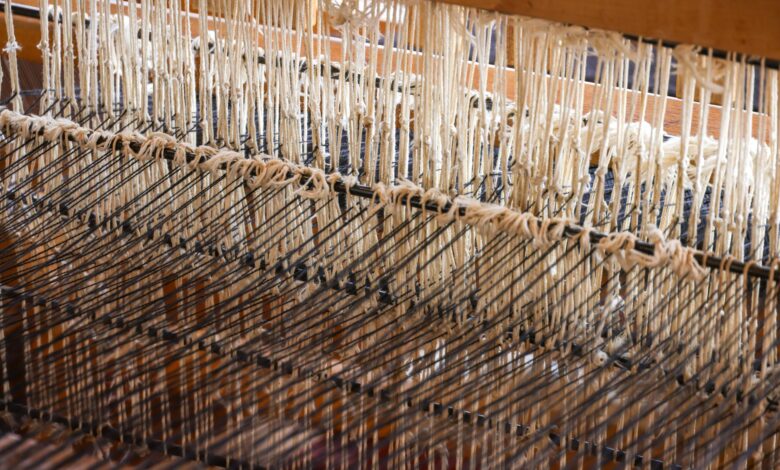
Thread count is less important than the packaging indicates; it indicates the number of individual yarns woven over a distance of the fabric, but is not comparable to other fabrics unless they are the same weave (i.e. single-ply cotton). In addition to the fibre itself, quality is determined by the staple length and the type of weave, which provide more information regarding the durability and feel of the fabric.
The Good Housekeeping Institute evaluated a total of 353 different sheet sets and determined that bed sheets with a higher thread count did not necessarily have a better quality than lower thread count sheets, nor did the higher count result in a greater degree of softness. Therefore, should you give any importance to thread count? Yes—but with limitations. For example, many companies will include as part of the count the number of threads that make up the yarn (the number used in making the yarn), and packaging will not usually indicate if this has been done. Below are details about the specifics of how to calculate the thread count; ways companies may pad the counts; other factors predicting better fabric; and how to take advantage of labels when selecting the right sheet for your needs.
What Thread Count Actually Counts
The mechanics of determining thread count are based on the bedding-related ASTM (American Society for Testing Materials) definition of thread count provided by the testing lab IDFL (International Down and Feather Laboratory). The ASTM definition specifies that the thread count is defined as the total number of warp yarns (also referred to as ends, which run the length of the fabric) plus the total number of filling yarns (referred to as picks, which run across the width) counted at a flat position on the surface of the fabric under no tensile load. The definition specifies that a single yarn or a plied yarn is counted as only one unit towards the total yarn count.
So the number comes from adding two counts together. In a 2005 interview, Auburn University fibre engineer Peter Schwartz explained that a balanced 200 thread-count fabric has 100 threads in the warp and 100 in the weft. Using the same arithmetic as a made-up example, a fabric with 140 ends and 140 picks per inch would be labelled 280. Consumer pages like Consumer Reports’ buying guide describe this as threads “per square inch.” That’s the usual shorthand for the per-inch sum, not a count of every crossing in a square.
ASTM D3775 describes the testing methodology for the thread count of all woven fabrics and provides reporting options for labs using both inches and centimeters. The most recent edition of the ASTM standard is D3775-17(2023) and includes the determination of end and pick counts for all woven fabrics. The ASTM standard D3775-17(2023) may be obtained for a fee from the ANSI listing, and as a result, the figure determined using this method in most cases would not be comparable to any figure based on an American inch count. Knitting does not fall under the jurisdiction of this standard; therefore, a separate method is available for determining thread count for knitted fabrics.
Why would a higher number of genuine yarns matter? Finer yarns take up less space so there are more of them per inch. “The finer the yarn, the softer and more flexible the fabric will be,” Schwartz told the Sun-Sentinel. Boll & Branch co-founder Missy Tannen, who was quoted by Wirecutter, explained it in more blunt terms: “Thread count is really only a measurement of density.” Density is determined by how the yarn was constructed, so thread count cannot be used alone to rank sheets.
Additionally, there is no practical way for a consumer to determine the number of threads in their sheets themselves. Schwartz stated that a consumer would need a microscope and an abundance of patience to determine the exact thread count on their sheets. Therefore, the label and its accompanying text will do the majority of the work for a consumer.
Why the Number on the Package Is Often Inflated
On the r/Bedding subreddit, a user looking to purchase good 1,000-thread-count sheets based on their friend’s opinion asked the community for guidance. One of the most popular comments on that thread contained a guess regarding a possible type of sheet. The user stated that those sheets were “most likely a 250TC with 4 plies or a 330TC with 3 plies.” This comment was purely a guess and is not a definitive measurement. However, it illustrates how this idea (of a manufacturer inflating thread counts through ply manipulation) works.
A plied yarn is where “two or more yarns are twisted together to create a single strand” (as per ATMI’s 2002 letter written to the FTC). Under the conventional counting method, that single strand is counted as one yarn, but under the “inflated” method, each individual ply would be counted separately as a thread. An example of this can be seen in ATMI’s explanation regarding a material that contains 250 four-ply yarns/inch as being referred to as a “250-thread-count” fabric. Therefore, if the same fabric were to be referred to as a “1,000-thread-count” fabric, it would be a “false” and “misleading” statement. The site Wirecutter gives a similar example, stating that a 500-thread-count sheet, which consists of two-ply yarns, would most likely be advertised as a 1,000-thread-count sheet. This has led to many users on the subreddit asking for more information about both plied yarn and thread count when purchasing sheets.
Litigation shows that thread count claims can be overstated further. A class-action lawsuit filed in 2022 claims a certain manufacturer sold a sheet set labelled “1250” (based on its being shown as having 1250 yarns per square-inch) but in fact, based on testing to ASTM D3775 showed 57 warp and 166 weft yarns per inch, totalling 223 yarns per square inch. According to the suit, the manufacturer multiplied the 57 warp yarns by the number of filaments in them (19) to arrive at 1,083 yarns and then added the 166 weft yarns for a total of 1,249 yarns. Separately, litigation over the same manufacturer’s “1250” label resulted in a settlement of $750,000, approved by the court in October 2025. Macy’s agreed to a $10.5 million payment to a settlement fund regarding allegations that Macy’s misrepresented the thread count of some of its sheets. A complaint sets forth a claim, while a settlement resolves that claim, which does not equate to a ruling that the represented numbers were inaccurate.
Ply is just one way to reach large counts. The manufacturer of fine polyester yarns has been reported to be producing them with the “sole purpose” of raising the thread count claim, according to Good Housekeeping. The subsequent sections review these claims.
What the FTC staff said
In January 2002, ATMI asked the FTC for a staff opinion and referenced ASTM D3775 as the long-accepted method for counting yarns. As set forth in the March 2002 response from the staff of the FTC, ATMI was advised by the FTC staff that ASTM D3775 is a significant factor in establishing a reasonable basis for any claim about material products. As later quoted in the 2022 complaint, the FTC staff’s March 2002 reply said it would give significant weight to the ASTM standard and that material product claims need a “reasonable basis.”
A clearer statement in August 2005 from the National Textile Association in a staff letter made it clear that the practice of stating an inflated thread count by multiplying the actual count by the number of plies of the yarn could mislead or deceive consumers. As Home Textiles Today reported, the FTC’s Associate Director for Enforcement James Kohm wrote, “Consumers could be deceived or misled by the practice of stating an inflated thread count, achieved by multiplying the actual count by the number of plies within the yarn.” He went on to say that labelling the product “300 thread count, 2-ply yarn” is an acceptable labelling method, whereas calling the same product “600 thread count” would likely mislead consumers. FTC Attorney Carol Jennings told the Sun-Sentinel that multiplying by ply is “inappropriate.”
The letter is an employee’s opinion and does not provide General Rule advice from the Commission. Wirecutter referred to it as “an opinion… not a set of rigid rules or guidelines,” and Jennings believed that a rule from the letter was improbable to become a rule. The report indicated that the issue falls under Section 5 of the FTC Act, which regulates against deceptive practices. Consumers were not the only concerned parties within the textile industry; a representative of one luxury-linen company stated that the U.S. Customs’ treatment of plies was not an issue and the Bedding Chairman of the National Textile Association responded that the U.S. Customs regulation only addressed tariff classifying and had “no relationship with retail thread count.” All of this information is U.S.-oriented and almost twenty years old. It is general consumer information, not legal advice for making labelling decisions.
The practical takeaway is: If you’re reading a thread count claim, you shouldn’t expect it to be objective. Rather, you should see the number on the package as a claim that you can verify. Is the use of the “thread count” claim still being used by most textile manufacturers? According to Wirecutter’s experts, while it’s less common for many textile manufacturers to make the “thread count” claim as frequently as they did in the past, it is still a common practice for some manufacturers they still see it, and Good Housekeeping also says that you don’t see it “quite as much anymore.” Plied yarn is not an inherently negative feature of plied yarns. One comment on r/textiles argued that “sometimes, especially when the fabric has a low TC, a fabric made with plied yarns can last for a very long time.” The reason the FTC asked to clarify and disclose how many plies can be counted and disclosed is that the existence of plied yarn should not be a consideration when measuring the durability of a fabric made from plied yarns.
What Actually Predicts Better Sheets
Testing done by independent sources suggests situations that are far from the truth. For example, in its latest test of 353 sets of sheets, Good Housekeeping had no correlation between thread count and performance. In addition, in Consumer Reports’ testing of sheets, the thread counts of the tested sheets ranged from 152 to 680; yet, according to Consumer Reports, thread count isn’t necessarily a sign of high-quality sheets. For instance, Consumer Reports found one of its top-performing sheets was made from 280 threads of Pima cotton in a Percale weave, and that same sheet was also Wirecutter’s favourite percale set. Other factors that determine the performance of sheets include staple length (the length of each individual fibre), weave, and finishing.
Fibre and staple length
When looking at the fibre component, Consumer Reports defines “cotton-rich” as any sheets that contain at least 50% cotton and the remainder made of other fibres. In cotton, staple length is an important component to consider. According to Wirecutter, shorter fibres tend to have more ends sticking out from the yarn than long-staple fibres. Short-staple fibres are associated with a rougher texture, therefore more likely to snag, pill, or wear through, than longer-staple fibres. Long-staple fibres range from approximately 1 ⅛-1 ¼ inches in length, while extra-long-staple (ELS) fibres are typically 1 ⅜ inches or longer.
The country of origin on a label does not necessarily mean a certain staple-length of cotton. According to Wirecutter, a label that just has “Egyptian cotton” could still be short-staple cotton, just because it was grown in Egypt. Instead, look for “long-staple” or “ELS,” or Supima, which refers to a trademarked U.S.-grown pima that is produced from licensed sources. You also want to look for Combed Cotton, which has had its short fibres removed before spinning, another quality marker. Even with these words, it is up to the seller to substantiate their claims about the product. A 2016 article by a major U.S. retailer confirmed in 2016 that between August 2014 and July 2016, one of their vendors was substituting non-Egyptian cotton in sheets listed as “Egyptian Cotton 500-thread count.” Consumer Reports also states that some manufacturers might mix cotton types.
Weave changes the right number
Percale is a basic grid of one thread over, one thread under, with a crisp, matte look and feel. Sateen has several threads that float over others, resulting in a smoother surface and softer drape, according to Consumer Reports. Wirecutter also explains that percale has a plain weave and, therefore, physically fits fewer threads than sateen. Sateen’s heavier weight means that a higher count is more relevant, as it reduces the likelihood of snags through the floating yarns. In February 2026, a post on the r/textiles subreddit made the same point regarding TC comparisons being virtually meaningless unless the weave type was also determined.
What constitutes an acceptable amount of TC for sheets will depend on the source, as the sources provide different ranges and the chart represents an aggregate collection of each source range.
| Source | Percale | Sateen |
|---|---|---|
| Wirecutter’s experts (Gopinath, Maher) | 250–300 optimal; 200 also good; over 500 “not necessary or likely” | 300–600 good; higher makes a very heavy sheet |
| Good Housekeeping | 300–500 for cotton (weave not stated) | Same range (weave not stated) |
| Consumer Reports, 2013 | “The sweet spot is 400” (weave not stated) | Same figure (weave not stated) |
There is considerable overlap in both the number ranges of 400 and 800 thread counts as stated above. Their ranges do not include the pursuit of four-digit thread counts. That’s the clarification for the question of 400 vs. 800 thread counts. Within Wirecutter’s multiples, the 400-count sheet falls in the sateen category, but it is found at the highest point in the percale, while an 800-count sheet would be located above both in the banding of products. According to Wirecutter, when looking at sheets with more than 300 counts (percale) or more than 600 counts (sateen) it sometimes mean ply inflation, so if I were to compare the two and say they are similar counts I would first need to find out what “number of plies,” if any, were used for the 800-count sheet.
Is it better to stay with higher thread counts than to go with lower? As with single-ply cotton sheets of the same weave quality, thread count indicates the finer yarn used to produce the sheet, but not as far as to what it is like as it gets finer than originally intended. High thread count sheets become heavier, thicker and denser than other sheets with the same count. Tannen, who is a manufacturer of sheets, told Wirecutter that if the count goes over a certain level [air doesn’t circulate well and “you’ll sleep hot,”] and therefore “it’s hot to sleep”.
Finishes and blends
The appearance of sheets in store can be misleading. Pat Slaven, a textiles specialist for Consumer Reports, stated in 2013 that many manufacturers treat their products with “hand enhancers,” which consist of silicone-based softeners that “wash out” after the first cleaning. Polyester and rayon blends further diminish the usability of thread count numbers. Good Housekeeping has reported that while polyester and rayon manufacturers can produce very thin strands that aren’t comparable to cotton threads; Therefore, their opinion of the 1,400-count cotton and polyester blend tested did not result in top ratings.
How to Read a Sheet Label Before You Buy
The checklist below outlines the information from the previous sections into labels on the package or product page, so that you can check that all information is supplied. Each row tells you what an informative label states about what it will give you and what else to look for closely.
| Label element | What to look for | Red flag |
|---|---|---|
| Fibre content | “100% cotton” or exact percentages (CR) | “Cotton-rich” (can be as little as 50% cotton) |
| Ply | The ply stated beside the count, e.g. “300 thread count, 2 ply yarn” (FTC staff example) | A high count with no ply information |
| Count vs weave | Roughly 200–300 percale, 300–600 sateen (Wirecutter) | Over 300 percale or 600 sateen, with no ply stated |
| Weave | “Percale” or “sateen” named | No weave given, so you can’t place the count |
| Staple | “Long-staple,” “ELS,” or Supima (Wirecutter) | Origin only, like “Egyptian cotton” |
| Yarn prep | “Combed cotton” | Not stated (unknown, not a defect) |
| Non-cotton | Judge by fibre and weave instead (GH) | A towering count on polyester, rayon, or a blend |
When reading the rows, the count comes last and is placed there for good reasons. A missing ply line indicates a deficiency of information, but does not demonstrate inflation. Some brands, as pointed out by Good Housekeeping, do not provide the cotton percentage or ply. When two sheets provide the same information, they should be compared to each other on that same basis, however when one of the two sheets doesn’t provide the ply along with a higher count, you are comparing a known with an unknown. It is wrong to discount a sheet because its yarns are plied. You may still refer to a disclosed multi-ply count as describing a well-made sheet, so comparisons should be conducted on the ply-adjusted count.
The example of FTC staff applies to U.S. labels only. The Textile Labelling Act for Canada requires producers to be identified, and quality claims must be substantiated. This regulation does not establish a standard thread-count method; if you buy outside of Canada, consult your local consumer protection agency.
Labels are unable to provide a complete guarantee of future performance; therefore, it is important to do a final check after making your purchase. According to Consumer Reports, you should always wash your sheets before using them. You also have the option of returning the sheets if they do not fit properly due to excessive shrinkage, or if you do not like the feel of the sheets. During their research, Consumer Reports found that cotton sheets can shrink as much as 6 percent. The report also noted that, often times, claims made by manufacturers regarding deep-pocket style sheets do not hold true, so be sure to keep your receipt.
The Last Check
The yarn count is just a count of the yarns themselves, and can only be fairly compared if the number has been recorded in the same manner. When looking at the number, first check the fibre type, the staple length and weave, as well as whether there is a notation indicating how many plies it is. After washing your sheets, evaluate their comfort and fit while you still have the option to return them. The Federal Trade Commission’s (FTC) staff guidance on ply applies only to things sold in the U.S., this guidance is not a law and the number on the package should be used as a representation to verify rather than to establish a grade.
Frequently Asked Questions
Is Egyptian cotton always better than pima or Supima?
A label that says “Egyptian Cotton” can sometimes simply mean it was made out of short staple cotton (cotton with a short fiber length) that was grown in Egypt. Long-staple Egyptian, Pima, and Supima all come from the same extra-long staple species of cotton. Instead of looking for the country name on the label, you should look for the words “Long Staple” or “ELS”.
Does thread count apply to linen, bamboo, microfiber, or jersey sheets?
It cannot be compared directly with cotton. The Good Housekeeping Institute explains that linen’s counts are inherently low due to its lower density than cotton and silk and flannel are measured using weight. Jersey fabric is made using a knit rather than a woven method. Polyester and Rayon (which is sometimes called “Bamboo”) can be spun very fine (ultra-fine).
Is a two-ply sheet worse than a single-ply one?
A single-ply yarn may not be automatically more pliable and tends to make softer fabric than a multi-ply yarn. According to Wirecutter, a single-ply yarn will tend to produce softer fabric, while a comment from an R/Textiles discussion forum member said plied yarn can be very durable. The FTC’s staff had a concern about double-counting plys as extra threads, not about whether they existed.
Do these thread-count rules apply outside the United States?
The FTC staff positions cover U.S. labelling only. Canada requires fibre-content labelling and accurate quality claims but doesn’t set a thread-count method on that page. For other countries, check the local consumer-protection authority.
