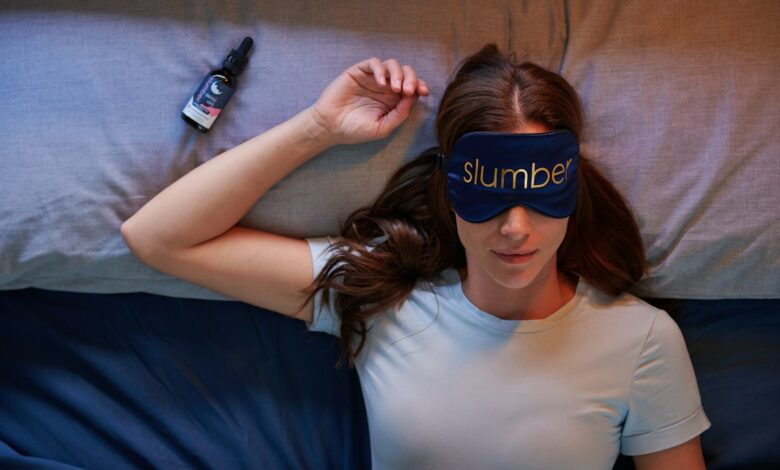
Sleep masks block out any light that gets to your face, while blackout curtains protect the entire room. The choice between a sleep mask and blackout curtains depends on how the unwanted light gets to you at night. A sleep mask does not stop the light from reaching your eyes; it just blocks it from getting to your face. If you close your eyelids, they are not solid black; they are transparent, which means that light can get through even if a blackout curtain is in place. Closed eyelids aren’t opaque.
When it comes to the fit of a sleep mask vs. blackout curtains, it becomes more difficult to choose. Consumer Reports conducted its own lab tests on sleeping masks and found that a curtain labeled as blackout may not actually block out all of the light it is intended to block out. When you wear a mask, it will only work when it stays in place. Therefore, neither a sleep mask nor blackout curtains can provide you with complete darkness at 3 a.m. You must consider what they are unable to block out of your sleep space first.
Curtains and sleep masks do not compete with each other because they block out light at different locations. Blackout curtains block out sunlight, streetlights, and headlights from outside before the light enters your room; therefore, curtains block out the light at the source. Sleep masks block the light that already exists in your room before it gets to your eyes (i.e., at the last point).
The distinction between these two tools determines who benefits and from what source. Consumer Reports points out that blackout curtains block the outside light from coming in. In order for blackout curtains to help improve your ability to sleep, you need to also consider internal light sources such as electronic devices or lighted hallways. A mask provides the opposite limitation. A mask is only effective for one individual and, CDC/NIOSH guidance says that for a mask to have any value, it must remain on the face for the full length of your sleep period.
The table below outlines which tool can provide coverage over which light source. The information represents a guide to what each tool offers as far as coverage of light sources.
| Light source | Blackout curtains | Sleep mask |
|---|---|---|
| Streetlight, headlights, early dawn through the glass | Can block it, if fabric and coverage are both good | Blocks it for the wearer only |
| Glow around curtain edges | Not solved by the fabric itself | Blocks it for the wearer only |
| Standby lights, clocks, chargers in the room | No effect | Blocks it for the wearer only |
| Hallway light under the door | No effect | Blocks it for the wearer only |
| A partner’s reading lamp | No effect | Lets you sleep while it stays on |
| Hotel rooms, flights, guest rooms | Stays at home | Goes wherever you go |
To interpret the table correctly; blackout curtains offer the greatest coverage option if the only concerns regarding sleeping in total darkness are related to the window location and that darkness is the desired effect for anyone sleeping within the room. A mask provides the ability to block multiple types of light sources but only from a single individual, for only the period of time it is utilized.
What light-at-night and sleep-mask studies actually show
One of the most frequently referenced studies appears to be that of Cardiff University, which conducted the first experiment where 94 people ages 18 to 35, all medically healthy, used a light-blocking mask for one week at home while the curtains were left open and then another week without the mask. The experiments took place during the summer when dawn arrives fairly early. While using the mask, participants showed enhancements in their ability to learn word pairs and reacted more quickly when performing the alertness test. However, the participants demonstrated no significant changes in their ability to learn motor skills over the course of the study.
The authors of this study do report several pieces of information that do not typically appear in the marketing literature. There were no changes in participants’ self-reported sleep quality or in their sleep diaries. A second experiment that utilized a home EEG headband found there was no alteration in the sleep structure associated with the use of the mask. Harvard Heath summarized the study by stating the use of the mask did not result in longer periods of sleep and did not positively affect how well people felt they had slept.
The learning results have also been questioned by researchers. A reanalysis was published by Stephen Rhodes that presented evidence that the mask did not provide any definitive or consistent evidence of enhancing learning. The original authors of the study defended their analyses but acknowledged that any cognitive improvements were quite small. In their reply, they also acknowledged that the number of participants in a particular task had been reported incorrectly as thirty-three and should have been corrected to twenty-eight. In summary, there is limited evidence of a small benefit to participants for a few specific tasks, and it should not be construed as proof of deeper or longer sleep.
Curtain marketing also has an extensive body of light research, although it too requires careful reading. A Northwestern University study published in PNAS compared 20 young adults who slept one night under 100 lux of lighting from above (ceiling) to those who slept under 3 lux of dim light. It was found that when sleeping at higher levels of brightness (100 lux), sleeping at a higher level of brightness resulted in a higher heart rate, an increase in insulin resistance the following morning, but their melatonin levels did not differ. The authors concluded that it is still unclear what the long-term effects of these results would be when applied to people in general. This was a controlled laboratory study of one full night of sleeping under ceiling lighting. Therefore, this study does not provide valid guidance regarding how much light would be provided through a curtain, nor what exposure range would be acceptable for use at home.
Most studies regarding melatonin claims are derived from an entirely distinct source of data. The study of Gooley and associates determined that exposure to room light during the late evening caused a delay in the onset of melatonin and a shortened duration of 90 minutes. The authors were able to demonstrate their strongest finding by keeping their study participants awake during their normal sleeping hours while being exposed to this form of night light exposure. This was done through evening exposure to room lighting, while their subjects were directly exposed to that form of lighting (as compared to sleeping while being indirectly exposed, like sleeping with a small curtain gap).
Consequently, researchers to date have not created a valid study that directly compares sleeping with an eye mask versus sleeping behind a curtain for an average adult. Research using newly developed light-emitting devices did not fill that gap in 2026. That study compared a vibrating eye mask with a similar non-vibrating one without curtains or darkening means. This research was designed to evaluate the efficacy of the vibratory nature of the eye mask versus simply being in darkness.
The best general target comes from a 2022 expert consensus for healthy adults aged 18 to 55. It says the sleep environment should be “as dark as possible,” measured at the eye. It also says these recommendations shouldn’t override visual safety, and that groups such as shift workers may need different advice. The information here is general and isn’t a diagnosis. Cleveland Clinic advises that a mask won’t make up for poor sleep habits or treat a sleep disorder, and that ongoing sleep trouble is worth raising with a healthcare provider.
Find your bedroom’s light leaks before you buy
Before making a purchase, you can do one thing that doesn’t require any money and it is really useful. Find out where all the unwanted light comes from when you are asleep. For example, if you check for light during the day, you may miss the streetlight that turns on at dusk. If you check while standing, you may miss the charger that only points directly in your eyes when your head is resting on your pillow.
Some amount of light needs to be in a room. The CDC/NIOSH guidance suggests keeping the path to the bathroom clear and using a dim red nightlight while getting out of bed at night. Consumer Reports also suggests putting your nightlight low to the ground, away from where you lie. Making the bedroom totally dark does not mean making it dangerous for everyone to walk through.
An assessment for where light comes into your room can be done in one evening without any points. It is only to show you where light comes from inside your bedroom.
- [ ] Do the check at your normal bedtime, and again near dawn if early light wakes you. Write down the time of each check.
- [ ] Lie down in your usual sleeping position, with your head where it normally rests, and let your eyes adjust for a few minutes.
- [ ] Look at the window. Notice whether light is coming through the fabric itself or around it, at the top, sides, bottom, or where the panels meet in the middle.
- [ ] Look at the door. NIOSH suggests turning off hall lights or putting a draft stopper under the door.
- [ ] Find every glow inside the room, such as clock faces, chargers, TVs, and air purifiers. Consumer Reports suggests covering indicator lights with electrical tape.
- [ ] Note any light you can’t control, like a partner’s lamp or a shift-worker’s schedule. That’s personal-coverage territory.
- [ ] Mark any light you want to keep for getting up safely, so you don’t count it as a leak.
- [ ] If you take photos, use them to record where gaps are. Don’t use them as proof of how dark the room is.
- [ ] If you use a phone light meter, keep it to before-and-after comparisons with the same phone, app, spot, angle, and time.
The last two items should be handled carefully. Photographs show light sources in the photo, but a normal photograph is not a means of measuring. NIST has done work on imaging and stated that taking measurements of light from a photograph requires a camera whose performance and exposure settings are tightly controlled and properly calibrated.
Also, phone light meters are the weakest at the particular range of light intensity that you would expect to find in a bedroom. One calibration study found that readings from the tested camera app below 100 lux varied by more than 50% even after calibration. In addition, camera app measurements of low light contain an error of about ±18%. A zero reading on a phone doesn’t prove your bedroom is dark. On top of that, regular lux readings are not the correct scale for determining melanopic content, as the expert guidance is based on.
Why blackout curtains can still leak light
A blackout curtain must pass two tests: the fabric itself must prevent light from passing through it, and the installation must prevent light from entering the room around the curtain; fabric testing only addresses one aspect of blackout curtains. For example, the AATCC TM203 test measures how much light is transmitted through window covering textiles but has nothing to say about the amount of light that enters through gaps at the rod/wall interface.
The results are quite variable for fabric alone; at Consumer Reports, testers placed a lit flashlight behind a curtain and determined how much light reached a white wall. Only two of the nine brands tested performed well at blocking light from any color of fabric. In general, darker colored fabrics blocked more light than lighter colored fabrics. Therefore, it is essential to pay attention to the specific color you purchase, not just the brand or description of “blackout.”
The installation aspect is another source of leaking light; one Mumsnet user articulated this very well. The amount of light that enters your room around the window area depends on the distance between the curtain rod and wall and how much the curtain overhangs the window. The responder added that if there are significant gaps around the curtain rod and wall, you will get a halo affect around the window no matter how blackout the fabric may be. While this comment is only one person’s opinion, it supports the recommendation by the IKEA rep quoted by Consumer Reports that both the rod and the curtains should extend past the edges of the window.
You might want to think again if your room doesn’t allow for curtains to be hung the way you want. There’s an instance documented on DIY Stack Exchange where someone had light coming through both the top and bottom of their curtain because they couldn’t make it longer due to having a radiator below it. They suggested using a second layer of curtain – a blackout roller blind on the window, and wooden strips along the sides to block any edge light getting through. So if you have an odd-shaped window, consider adding an additional layer of curtain instead of just getting a thicker one.
Additionally, when you purchase, compare the entire package, not just the initial price. For instance, on this IKEA US listing, they provide the number of panels included in each pair of curtain, the dimension of each curtain, and care instructions, all separately. If you find a good deal on a single panel but intend to use them for a large window, you will need to purchase additional panels. If you plan to hem your curtains, it’s better to wait until after the first wash before hemming them as many will shrink when washed according to Consumer Reports. It is also advisable to purchase from retailers that offer generous return policies.
Do not assume that having a blackout label on a window covering means that it also provides thermal insulation properties. Consumer Reports conducted a separate test for thermal insulation; while the Department of Energy has a guide specifically dedicated to how window coverings can assist with temperature reduction. Therefore, it is essential to differentiate between light-blocking and thermal insulating purposes for window coverings.
Check sleep-mask fit in the position you actually sleep in
A mask’s fit is more important than what it is made of. Tests performed across 17 masks by Which? showed that the amount of light blocked from coming into the mask was dependent on the fit of the mask, with light coming in through the sides of the eyes and nose being the largest issue. The ability to hold the mask in place when the wearer was lying down was also one of the tests’ components.
A tighter strap will not always keep a mask in place. On Stack Exchange, one user noted that while the user’s mask did not stay on throughout the user’s sleep, a tighter strap caused discomfort around the user’s eyes. “If I tighten the strap then it presses uncomfortably around my eyes.” Cleveland Clinic’s advice describes the balance to aim for. A good mask fits snugly without feeling tight, stays in place when you change position, and blocks light without pressing on your eyes. If you can only stop a mask slipping by making it uncomfortable, it’s the wrong shape or strap design for you.
Some masks that have raised bumps or “cups” around the eyes help with opening and closing the eyes during use, but they also cause their own problems. Memory foam sleep masks with a concave eye-patch design allow the user to open and close their eyes freely, however they tend to get hot and make sleeping uncomfortable. For those who are side sleepers, one of the main issues is “bulk”. Paul Lester, the technology editor for Which? who is also a side sleeper, likes mask designs that have raised sides but recommends against using those types of masks that have “too chunky around the sides”. He prefers side-sleeping teardrop style masks. Just because a contoured sleep mask is contoured does not mean it is a better design. The best contoured sleep mask will be the one that fits your face and pillow correctly.
To properly judge whether or not a mask is going to fit properly, wear it lying in your normal sleeping position during the day while in a lit environment. Put your head in the same position you would while resting your head on the pillow at 2 a.m. and then see where you can see light through the mask, and if you feel any pressure from the mask when you move your head back and forth as you would when sleeping all night long. For most people a good fit test from the edge of their bed will not determine whether or not the mask will fit when you are actually using it. A good test in the morning will most definitely give you an indication as to whether or not the mask worked as intended through the entire night. If at any time during the morning you find the mask resting on your forehead or lying on the ground next to your bed, you know that the mask was not able to block out light effectively for you during the night.
When to choose a sleep mask, blackout curtains, or both
Once you understand your light source and the distance you can reach with each of your light-source tools, most of the rest of your decision will be made for you. What you should look for is the best sleep mask and/or curtain for you—one that will completely block all of your actual light leaks and one that you will continue to use consistently every day.
In general, a sleep mask may be the more convenient choice if the light is something personal to yourself or if you regularly travel; as an example, a sleep mask works especially well if you are travelling, if you have a partner who reads in bed, if you live in a rental unit that requires you to hang your own pictures and/or if you live in a room with lots of illuminated objects (night lights, alarm clocks, etc.); Dr. Samuel Gurevich of the Cleveland Clinic notes that masks may help people who work the night shifts, those who live by the side of the street (or in an apartment with big windows), or that travel frequently may benefit from using a sleep mask. The only drawback to using a mask is that when it is on your face it must stay in place for you to get any benefit from it.
Sleep masks are generally more appropriate when the primary source of light in your bedroom is from a window, and you share a bedroom with multiple people or are not comfortable having something on your face. For those individuals who work night shifts or live near the city; NIOSH recommends that they use opaque window treatments (black-out curtains), and that they block out excess light on the edges of their windows. If you cannot hang any window coverings, you may need to check with your landlord first before you install them. However, using a sleep mask eliminates this problem altogether, as it is an item that can simply be taken off at bedtime.
Using both types of window coverings is logical because each will cover areas not covered by the other type. For example, several people on the Mumsnet thread indicated that they combine blinds/roller shades with blackout curtains to get the best overall effect. One user indicated that wearing a sleep mask allowed her to sleep well into the summer morning when she left her window open. On the other hand, if you have already achieved total darkness from your blackout curtains and have no glowing devices inside the room, wearing a sleep mask is going to be of little value to you. However, if you have light coming through gaps around the window frame or your spouse leaves a lamp on in the evenings, then getting an additional tool, such as a sleep mask, is a very real solution to closing that gap.
Don’t prevent yourself from receiving light that you actually want. Phyllis Zee, a sleep specialist, told Consumer Reports that having a curtain that allows light to pass through (such as sheer curtains) can help people who have difficulty waking up by giving them morning light before they are ready to get out of bed. If you wear a sleep mask, then you will get that light as soon as you remove the mask.
If you see the OEKO-TEX® label, be sure to understand what it refers to. STANDARD 100 states that textile products have been tested for the presence of harmful substances. However, it has stricter restrictions on products that are designed for close skin contact than it has for products that serve decorative purposes, such as curtains. Therefore, it does not provide any indication of how effectively the curtains block light or whether the curtains will fit or feel comfortable when hung. So, if you are looking for the OEKO-TEX® label, be sure to look for that specific product.
The Practical Verdict
Both curtains block out the light coming through a window into a room, while a mask blocks it out only for your eyes; however, neither has been scientifically proven to help promote sleep, nor do any studies directly compare the two products on waking adults. So, if you’re thinking about buying something to block out the light in your bedroom, I’d recommend lying down in bed to determine where the light may be coming from before you purchase anything: whether it’s through the fabric of your curtains, from around the edge of your curtains and window, through the cracks beneath your door, or from other items located within the room. That way you’ll know exactly which product(s) will best meet your needs and prevent you from spending money on something that won’t help you.
Frequently Asked Questions
Will blackout curtains help keep the room cooler? Not necessarily. Consumer Reports scored insulation separately from light blocking so that just because a product has a blackout label, doesn’t mean it will provide heat insulation.
How can I evaluate the light-blocking ability of a blackout curtain prior to purchasing one? First, Consumer Reports recommends holding the curtain fabric up to a flashlight while in the store. It is also advisable to purchase your blackout curtains from a retailer who offers a good return policy, in case you find that the specific color you were interested in does not block enough light (the test results revealed that lighter color curtains blocked less light than darker colors).
Does the room need to be completely dark for optimal sleep? The expert consensus agrees that having an optimal sleep environment means having it “as dark as possible.” However, according to Dr. Chris Winter of Consumer Reports, “some light-blocking ability is better than none” and that some ambient light can help guide you safely throughout your home during the night.
