
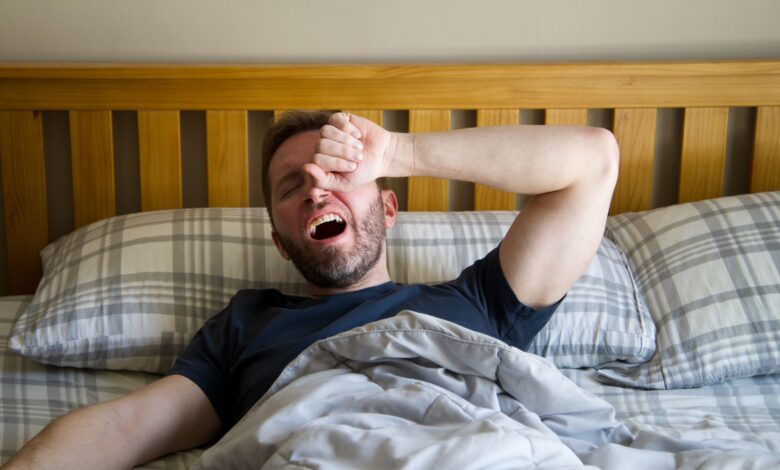
Sleep inertia typically causes a state of grogginess immediately upon waking, it is a temporary reduction of alertness and mental clarity, caused by the transition of the brain from sleep to awake mode. Most people experience sleep inertia or grogginess, for example, in the first 30 minutes after sleeping, but several factors play into the duration of how long grogginess lasts. An extensive review of several studies identified sleep inertia following an eight-hour period of sleep, not just after short naps. The classic review of the research notes that its effects can show up after a normal eight-hour night, not only after naps.
A state of grogginess that resolves itself before breakfast is distinct from continued excessive daytime sleepiness. Alertness can be experienced differently than measured performance, and [subjective alertness and measured performance can recover at different speeds]. While individuals may feel more alert than at any other time of day, recovery rates may vary greatly between subjective alertness and measured performance recovery. This information is provided for reference only; do not take it as an individual recommendation or a diagnosis of any specific condition(s). Below, you will find additional information on what causes sleep inertia, typical time frames for recovery, and specific ways to alleviate the condition.
What Sleep Inertia Actually Is
Sleep inertia refers to a state of confusion and/or low alertness upon waking from a night’s rest (e.g., feeling as though you need to go back to bed, impaired performance, reduced vigilance, and a desire to return to sleep). According to the most recent clinical review, sleep inertia is a normal occurrence; it is not a disorder. According to the CDC, NIOSH training module, some examples of the effects of sleep inertia include slower reaction times, decreased short-term memory, and slower response times when reasoning, remembering, learning, etc. The health-system overview (Baptist Health) provides additional examples of sleep inertia, including: disorientation, irritability, impaired communication, and reduced coordination.
Sleep researchers view sleep inertia as a separate entity from the effects of sleep on the body. In the three-process model, sleep inertia opposes sleep pressure and circadian rhythms, both of which affect how alert an individual feels during the day. Because of this opposition, sleep inertia is believed to act briefly on an individual immediately after awakening, and therefore the individual may feel groggy even after a full night’s sleep due to low sleep pressure and an established circadian rhythm.
The most important distinction between sleep inertia and excessive daytime sleepiness (or the length of your morning grogginess) is in the fact that sleep inertia will typically resolve within a relatively short period (i.e., minutes). In a recent large-scale survey conducted in Korea involving 2,355 adults, researchers found that greater levels of excessive daytime sleepiness among adults in Korea were only associated with longer morning grogginess among a smaller subset of those surveyed. Their conclusion was that excessive daytime sleepiness and longer morning grogginess may be two independent symptoms that require different assessments. Morning fog is a sign of sleep inertia; if you feel as if you could fall asleep around noon, that would indicate something else entirely.
A person’s unique waking state does not always fit a specific label. A Reddit user mentioned that they sometimes wake up in a similar state to sleep inertia but referred to the mental state after waking as an opposite version of what others describe as being foggy after waking. This person did not experience the typical feelings associated with sleep inertia, and instead experienced a heightened alertness and more of a feeling of clarity. This user’s experience is not common for most people who wake from sleep and may not fit into the definition of sleep inertia as described in most research. This user’s experience should be considered a valid reason for a person to consult with a healthcare provider about their specific experience instead of just categorizing it as a standard experience.
What Is Happening in Your Brain When You Wake Up Groggy
According to tests of brain activity, as observed through the use of electroencephalograms (EEGs), when a person wakes from sleep, there are slow “delta” waves present on the EEG, which are associated with deep sleep, usually from the time they fall asleep until they switch to faster “beta” waves for the first few minutes after waking, more slow “delta” activity (associated with deep sleep) and less fast “beta” activity (associated with wakefulness). The back of the brain returns to full function later than does the front of the brain.
Additionally, brain regions recover from sleep at different rates. A PET study (summarized in Trotti’s clinical review) of adults who were partially sleep-deprived showed that brain activity in areas (blood flow) related to sleep recovered to pre-sleep levels within five minutes of waking, while blood flow to the prefrontal cortex (involved in planning, judgment, etc.) took five to twenty minutes to return to normal. This difference in speed of the recovery can be seen in the experience of being able to get up and walk to the kitchen, but being unable to think properly until five to twenty minutes after waking.
In a combined EEG and fMRI study of 34 participants who napped for 45 minutes after being sleep-restricted, they showed no ability to perform arithmetic tasks five minutes after waking from sleep and the brain activity of these participants still showed signs of sleep. The participants showed greatest disruption if they woke from N3, the deepest stage of non-REM sleep. The separation of the “default mode” network (which is active during rest and mind-wandering) and “task-focused” networks (which are active when you are engaged in a task) disappeared when they were partially sleep-deprived. The disruptions were significantly lessened within the first thirty minutes after waking. As the participants were young adults who were experiencing extreme sleep deprivation, the study shows the maximum effect of sleep deprivation, not an average morning scenario.
The adenosine explanation has been proposed as the leading chemical reason for sleep inertia. Adenosine builds up in the body as you are awake and causes you to feel tired. The theory is that during sleep we may wake up before our bodies have eliminated all of the adenosine present in our bloodstream, and waking can happen before adenosine is fully cleared. A study showed that when people ingested caffeine before going to bed, it blocked the receptors for adenosine in the brain, leading to less sleep inertia when they woke up, and caffeine, which blocks adenosine receptors, suppressed sleep inertia when taken before the sleep period. However, this same review points out that adenosine cannot explain all the observations of sleep inertia and does not yet identify the complete mechanism through which sleep inertia occurs. Therefore, it is most appropriately viewed as an important lead but not a definitive conclusion.
How Long Sleep Inertia Lasts — and Why the Numbers Vary
The duration of sleep effect studies generates an array of numbers ranging from 1 minute to several hours. These numbers do not essentially contradict one another but rather provide answers to different types of questions, e.g., how alert people feel after waking versus how quickly they are able to react to stimuli; how different waking conditions affect response time and so on; how the studies define “over” can vary quite a bit. According to the Tassi & Muzet review, the results of sleep effect studies “should be analysed according to the type of task and context of the study”. The table below illustrates how variations in settings affect results.
| Source | What was measured, and in whom | Reported duration | Why the number is limited |
|---|---|---|---|
| Tassi & Muzet review (2000) | Many earlier lab studies, various tasks | 1 minute to 4 hours; rarely over 30 minutes without major sleep deprivation | A range across studies, not a typical person’s morning |
| EASA-commissioned systematic review (2023) | 70 studies, mostly lab-based healthy adults, objective performance | 0 to 35 minutes across most awakening types; one study found 60 minutes in medical interns after an on-call night | Built for aviation questions; many studies tested at wide intervals |
| Hilditch & McHill review (2019) | Lab studies comparing post-sleep with pre-sleep performance | Usually back to pre-sleep levels within 30 minutes, sometimes 15; full recovery may take at least an hour | In the longest-tracked study, the morning rise in alertness from the body clock could not be separated out |
| Kim et al. nationwide survey (2026) | 2,355 Korean adults answering one question about how long morning grogginess takes to clear | Average 15.8 minutes; median 10 minutes | Self-report only; cross-sectional; shift workers excluded |
| Leong et al. nap experiment (2023) | 32 young short sleepers after 10-, 30-, and 60-minute afternoon naps | Slower processing at 5 minutes after the 30- and 60-minute naps, resolved within 30 minutes | Small sample; testing only at fixed time points |
| CDC/NIOSH nurse training module | Occupational summary of published research | Typically 30 to 60 minutes, observed up to 2 hours; usually not over 30 minutes unless sleep deprived | Summarizes other studies; the page presents both figures |
In contrast to the majority of reports on long sleep effect durations that were generated by a protocol that observed participants for an extensive period after the standard morning wake-up time. The authors of that report noted that in essence, individuals’ self-reported levels of subjectively perceived alertness continued to improve until approximately two hours post-normal morning wake-up and performance on an addition task took up to 3.5 hours to fully recover. The Tassi and Muzet authors stated that the data from that protocol could not distinguish between the effects of the diurnal increase in alertness as determined by the body clock and the sleep inertia from waking in that protocol.
Combined together, the different studies suggest that it is not appropriate to provide a single number to indicate the speed of recovery from sleep inertia, but rather to consider the aforementioned factors. The steepest parts of the fog typically dissipate within the first 15-30 minutes. The remaining, slower part of the fog, may last longer in cases where a person has had a shortened overnight sleep duration or has awakened at an inappropriate biological time. The same is true for an individual’s “normal” level of recovery due to the level of perceived alertness and actual performance on tasks. The aforementioned 2019 review as well as the EASA report both concluded that how alert an individual feels is not necessarily a good predictor of their actual performance.
What Makes Sleep Inertia Worse — and What Makes It Better
Not all mornings start smoothly due to many factors occurring simultaneously. Each factor is specifically matched up with what evidence founded the research and where empirical evidence ceases. As such, this table is designed to help you identify a pattern in your own life but is not intended to be utilized as a means of diagnosing any condition(s).
| Factor | What the evidence shows | Source and its limits |
|---|---|---|
| Too little prior sleep | After chronic restriction to about 5.6 hours a night, performance right after waking was about 10% worse and had not returned to baseline 70 minutes later | Hilditch & McHill review; lab protocols, mostly young adults |
| Waking during your biological night | Inertia is greatest near the low point of core body temperature, in the hours when your body expects to be asleep | Hilditch & McHill review; Silva & Duffy forced-desynchrony study (10 older adults) |
| Waking from deep (N3) sleep | Older work found deep-sleep awakenings produce the most inertia, with REM intermediate; newer studies are mixed, and the effect shows up mainly after long naps or high sleep pressure | Tassi & Muzet; Hilditch & McHill call the evidence hard to synthesize |
| Longer naps | 30- and 60-minute naps produced measurable inertia; 10-minute naps did not | Leong et al.; 32 young adults, afternoon naps |
| Evening chronotype (“night owl”) | Evening types reported longer morning grogginess (17.7 vs. 14.3 minutes for morning types); a lab study found later chronotypes took longer to recover | Kim et al. survey (self-report); lab finding cited in Hilditch & McHill |
| Anxiety and insomnia symptoms | Participants with anxiety reported 29.9 vs. 15.6 minutes, the largest effect in the survey; insomnia was linked to longer inertia across all chronotypes | Kim et al.; only 34 participants screened positive for anxiety; association, not cause |
| Age | Evidence conflicts: one small study suggests older adults may be more vulnerable because they wake earlier in their body-clock cycle and more often from non-REM sleep; the Korean survey found no significant overall age difference | Silva & Duffy (did not directly compare age groups); Kim et al.; the EASA review drew no firm conclusion |
| Medications and health conditions | A hospital health-information page lists antihistamines, opioids, beta-blockers, benzodiazepines, and alcohol, plus depression, bipolar disorder, and obstructive sleep apnea, as raising the likelihood | Baptist Health (a first-party summary); a countermeasure review notes very little research exists in this area |
If you regularly experience prolonged grogginess lasting over a period of hours in conjunction with developing excessive daytime sleepiness even after an adequate amount of sleep, or if you experience heavy snoring and/or gasping for air or stopping breathing while asleep, please take this table with you to a healthcare provider for help. If you are currently taking a medication listed above, please talk to the prescribing physician about whether to stop taking it or changing the dosage instead of doing so on your own. The last section contains questions you might want to ask your healthcare provider.
As related to the “better” aspects of the table, much of its content represents a reversal of that which is presented in the “worse” aspect of the table. For example, getting enough sleep each night, awakening at the time expected by the body’s internal “clock,” and taking short naps all help decrease the chance of being impacted by a heavy fog. Importantly, the 2019 review presented here cites that sleep inertia has been observed in healthy, rested individuals who wake at their usual times regardless of the presence of many of the protective factors listed above. Thus, although minimizing and/or mitigating risk factors leads to shorter duration and less severity of fogginess during the morning to some extent, completely eradicating its occurrence is unlikely to happen.
Naps and Grogginess: Why Length and Timing Matter
The easiest illustration of the tradeoff between nap length and grogginess would be the research of Leong et al. In their study, every one of the different length naps, from 10 to 60 minutes in duration, improved the individual’s overall mood and created less daytime sleepiness for up to 4 hours after waking. The only measurable alteration in performance following awakening for both the 30 and 60 minute naps was a reduction in reaction time that occurred 5 minutes after waking and had disappeared within 30 minutes. The only naps of sufficient length to have a benefit related to memory encoding were the 30-minute napping episodes. The authors concluded that there was no one particular length that was superior for each individual but that for the young adult sample, the 30-minute nap provided the best combination of practicality to benefit ratio.
The Mayo clinic‘s guidelines for napping are relatively conservative, generally recommending a nap length of 15 to 30 minutes at around 2-3 in the afternoon, and advising that if you awaken feeling groggy from a nap, that is an indication that you overslept. Aspects of the data concerning the duration of naps and grogginess are quite conditional rather than absolute. According to a clinical review, naps of less than 20 minutes in duration, taken after a night of 5 hours sleep, did not produce performance impairment whereas 30-minute naps did. However, you may experience grogginess and performance impairment after shorter naps when you are sleep deprived. In one case, a 10-minute nap taken at 7:00 a.m. after a long night without sleep produced a temporary reaction time impairment.
The time of the day also appears to impact performance and grogginess as much as the duration of the nap. An example from a study summarized in the EASA review concluded that a 30-minute nap ending at 4:00 a.m. had lasting impacts on attention impairment 47 minutes after waking, which is significantly greater than what was observed with afternoon napping.
This is considered more of a guideline than an absolute rule. If you want to be very alert shortly after waking from your nap, you should aim for a brief mid-afternoon nap that has the lowest possibility of impairment. If you take a longer, or evening, nap, you should plan to have additional time to prepare for tasks requiring clarity of thought before beginning the tasks. The recommendation by the Mayo Clinic to give yourself time to wake up before resuming activities is especially relevant when taking a long nap.
The “Wake at the End of a Cycle” Claim: What the Evidence Says
The sleep cycle calculator uses 90-minute increments to determine when to go to bed and when to wake up. The underlying rationale is that individuals will wake just after the end of a sleep cycle, rather than being jolted awake from deep sleep and feeling groggy afterwards. According to the Australian Sleep Health Foundation, the assumptions of the calculator, as well as the advice provided by it, are “not supported by scientific evidence.” A study of each assumption shows where the logic breaks down.
The first assumption is that each sleep cycle lasts for 90 minutes. According to the Australian Sleep Health Foundation, while 90 minutes is an average of how long sleep cycles last, sleep cycles are actually different from person to person and can vary anywhere from approximately 60 to 110 minutes in length. Additionally, sleep cycles can change between different nights for the same individual. The second assumption is that you know exactly what time you fell asleep. However, according to the Australian Sleep Health Foundation, how long it took to fall asleep varies greatly among people as well as between nights. The third assumption is that there will be no interruptions to the sleep cycle(s) during the night. In fact, it is normal to have many brief awakenings throughout the night and how much time will be spent awake throughout the night is also unpredictable. Each of these three errors causes a significant difference in the timing of the alarm and in fact when the three of these errors are added together over the course of a night they create multiple errors.
Your body’s level of arousal when you wake up is determined by the depth of the sleep, and while it has some support from the Tassi and Muzet review on the effect of sleep staging on wake inertia (an inertia associated with waking at a deep sleep stage) compared with light sleep, there is some mixed evidence in the later review that states that the depth of the wake stage has no bearing on the performance of the sleeper following the awakening. The most meaningful factor seems to be the consideration given to depth of sleep when creating the sleep schedule following long sleep or heavy sleep pressures. Therefore, it is impossible to accurately find one’s ideal alarm stage based solely on a mathematical formula.
The absence of a controlled trial examining alarm clocks that have timers created by calculators versus regular alarm clocks does not mean that this method does not work; rather, it indicates that the claims made about these devices were based upon anecdotal evidence or opinions and were not substantiated through scientific testing. The Sleep Health Foundation provides an alternative (less exciting) method based on research that is better supported than using a timer calculator to create an alarm clock; maintain a regular sleeping and waking schedule so your body is prepared to hear the alarm bell. This finding reinforces two of the major factors displayed above in the chart (getting the proper amount of sleep and waking up at the right time based on biological rhythms).
What Can Actually Help You Wake Up Faster
An instant solution has yet to be discovered. A systematic investigation of how countermeasures used after awakening performs showed that the current literatures “offer insufficient scientific evidence to support any of the available countermeasures” and that a later review demonstrated no immediate effect of any of the measures listed here. The evidence compiled from the investigations listed below supports some measure equally.
| Measure | Best evidence found | Where it falls short |
|---|---|---|
| Caffeine before a short nap | Shown to ease inertia after a short nap such as 20 minutes; called the most effective preventive measure | Only works if you plan ahead; it can disturb sleep if you need to sleep again soon (Hilditch & McHill) |
| Caffeine on waking | In one trial, 100 mg caffeinated gum chewed right after waking improved reaction-time performance at 12 to 18 minutes | No effect during the first, worst minutes; the placebo group did not consistently show inertia (Hilditch et al.) |
| Bright light after waking, or a dawn simulator before | Improved how alert people felt in some studies | Did not reliably improve measured performance; all three dawn-simulator studies were funded by manufacturers (Trotti) |
| Sound and music | Pink noise helped after a midnight nap but not at 4 a.m.; preferred music improved some performance for up to 20 minutes | Small, mixed studies (Hilditch & McHill); a 50-person survey linked “melodic” alarms only to lower perceived inertia (McFarlane et al.) |
| Face-washing, cold cloth, cooling | Face-washing improved alertness ratings within a minute; one study found a cold wet cloth plus a fan breeze improved post-nap performance | Face-washing showed no objective benefit (Hilditch et al.); cooling evidence is preliminary (Trotti) |
| Exercise or movement | Proposed because inertia involves slow recovery of blood flow to the front of the brain | No intervention studies found by the 2019 review |
Although the above research does not provide a complete understanding as to what makes a successful countermeasure for the individual, it does provide a list of countermeasures with varying amounts of support. The most studied countermeasure on the list is the caffeine-plus-short-nap combination; while this will be used for planning purposes only, it does not provide an adequate list of all caffeine doses to date. The 100 mg of caffeine used in the one study referenced above does not represent the individual’s maximum potential for caffeine consumption; therefore, if you have any of the aforementioned concerns regarding heart health or pregnancy and plan to consume caffeine, consult with your physician.
Many individuals have constructed personal strategies using the lower-evidence alternative countermeasures. A Reddit member who had “very severe sleep inertia” described that he or she successfully used several methods of waking, including using a dawn simulator alarm and having a second alarm in a different location (bathroom), performing gentle yoga, and reading outside during the day. These actions have a positive correlation with light and physical activity, which can help to make people feel more awake. This does not necessarily mean these methods will help you to think clearly, but the increased feelings of being awake may make it easier to get out of bed.
The measures with the best support work before the alarm rings: enough sleep, regular sleep and wake times, and short naps timed away from the biological night. These match the planning guidance in the 2019 review, which cautions that following it lowers the risk but does not guarantee waking without inertia. Once you are awake, the most dependable measure is time.
When Grogginess Is More Than Sleep Inertia: Questions for a Professional
The relative severity of normal sleep inertia is much greater than that of sleep inertia. In a clinical review, Trotti describes “sleep drunkenness,” which can be characterized by pronounced confusion and sleepiness upon waking. Sleep drunkenness is a hallmark of idiopathic hypersomnia, and it is also commonly seen in patients with delayed sleep phase syndrome, which is a disorder in which the natural sleep-wake cycle runs late relative to other people’s cycles. In the earliest clinical description of sleep drunkenness, sleep drunkenness lasted for up to four hours, was marked by confusion, slowness of thought, and motor coordination, and many [idiopathic hypersomnia] patients required assistance waking up from sleep, which is an indication that sleep drunkenness is fundamentally more intense than normal sleep inertia. In this same review, Trotti also found that many patients with mood disorders experienced significant difficulty waking up and that their difficulty waking was a result of mood symptoms as opposed to sleep disorders.
According to Stanford Health Care, idiopathic hypersomnia should be diagnosed in someone who experiences significant difficulty waking up due to a lack of energy despite sleeping a significant amount of time every night. Stanford says to consider eloping if symptoms persist for three months or longer and negatively affect the patient’s ability to function in daily life. In contrast, the NHLBI lists symptoms of sleep apnea as having broken breathing with frequent loud snoring and gasps for air while sleeping, in addition to excessive daytime sleepiness. The NHLBI recommends that you see a health care provider, who may order a sleep study. Finally, Mayo Clinic states that if you feel the need for a daily nap to combat fatigue, it could be due to a sleep disorder or a side effect of your medication, and it is worth mentioning to your care team.
There is no specific time frame that distinguishes between normal and abnormal daily sleep patterns. However, the pattern of sleep-waking-tiredness will provide a guide for distinguishing between normal and abnormal types of sleep patterns. The pattern of sleep-waking-tiredness will be characterized by the frequency, severity, duration, and accompanying symptoms experienced. Useful questions to bring to a clinician include:
- Does my grogginess fit ordinary sleep inertia? Describe how long it usually lasts, whether you need help or many alarms to get up, and whether it has lasted months.
- Could a sleep disorder be involved? Mention daytime sleepiness despite enough sleep, and any snoring, gasping, or breathing pauses a partner has noticed.
- Could my body clock be the issue? Ask whether your sleep timing runs late enough that your alarm lands in your biological night.
- Could a medication or mood symptom play a part? List everything you take, and mention low mood or anxiety, without stopping anything on your own.
- Do I need a sleep study? Ask what would justify one in your situation.
Being careful is required when driving or doing other critical work, even if you are groggy from lack of sleep. Based on one study that reviewed more than 400 US Air Force accidents, many pilot-error accidents occurred within one hour after a pilot woke up from sleeping. The recommendations from the countermeasure review indicate that we should not do any safety-critical work within that hour. “I feel fine” is not an accurate measure of how well you can perform or if you are alert enough to drive safely, so if you cannot wait until that hour has passed, consult either a physician or your company’s safety policies to get advice that suits your particular situation.
Making It Work
Grogginess in the morning is often referred to as the “sleep inertia”. The brain is in transition, and this is a common occurrence that will generally pass within the first thirty minutes of waking. However, if you have had a short night of sleep or have taken a long nap in the middle of your biological day, this transition may take longer than thirty minutes to resolve. Therefore, if you want to avoid this grogginess in the morning, you should establish a nighttime schedule for sleep and keep your naps to a minimum. This will help your body to maintain a consistent sleep-wake cycle, which is more beneficial than any alarm-time calculator or quick-fix solution that may be available to you. It is also recommended that you wait for at least thirty minutes after waking up before operating a vehicle or making major life decisions. The feeling of alertness that you will experience in the morning will return before your actual mental sharpness returns. If the feeling of grogginess is consistently present for hours after waking and is coupled with daytime sleepiness or difficulties with breathing during sleep, you should seek help from a clinician rather than trying to improve your sleep routine by yourself.
Frequently Asked Questions
Does hitting snooze make sleep inertia worse?
Probably not: a laboratory study of 31 habitual snoozers found no evidence that snoozing (30 minutes) resulted in increased levels of sleepiness or mood and a slight improvement in some measures taken during wakefulness. The conclusions drawn from this evidence are not definitive and apply primarily to those who are regular ‘snoozers’.
Can a smartwatch or sleep-tracking alarm wake me in light sleep?
The research cited does not provide cutting-edge evidence for looking at snoozing. As stated in a 2023 snoozing study, ‘wearable technologies’ cannot accurately measure sleep stages; this is what these alarms use to predict when to wake you. Also, the effect of stage of waking on mixed effects on inertia has also had mixed results in the literature.
Why am I groggy even after eight hours of sleep?
You do not have to lose sleep to experience sleep inertia. According to Tassi and Muzet, and in their systematic review, people can have sleep inertia after having a sufficient night of sleep (i.e., eight hours of good quality sleep). As well, sleep inertia is observed in well-rested people waking at their usual time, though it is usually milder then.
Is sleep inertia worse for night owls?
A limited amount of data, limited to a nationwide survey of night owls, indicate that night owls experience more sleep inertia (i.e., longer periods of feeling groggy) than day owls (i.e., morning types). A clinical review notes that night owls report more inertia on workdays but not on days off, which points to early alarms rather than chronotype alone. In addition to being influenced by being awakened early from their normal sleep schedule, sleep inertia is believed to be increased by early morning alarms.
