
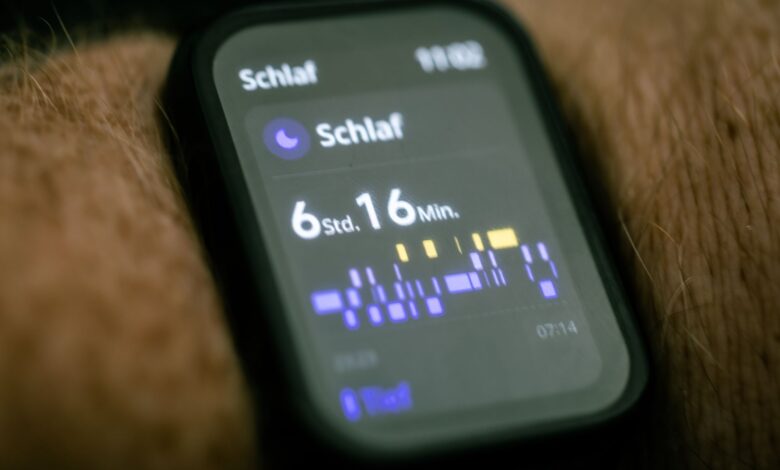
Sleep trackers are accurate when measuring how long someone has been asleep, but they are often much less accurate at measuring how long someone has been awake. A lab study conducted in 2025 of six wrist-worn devices found that while the six wrist-worn devices tested correctly identified that over 90% of the total amount of time a person slept was spent sleeping, only 29%-52% of the total amount of time a person was awake. Thus, the accuracy of your sleep tracker is dependent upon which measure you are using.
While an average of a group may be similar to a sleep study, you should not expect your individual night to resemble that of the group’s findings. Total time spent in various stages of sleep, including deep sleep, is the least accurately measured category across all types of sleep trackers. Several sleep tracker features approved for use in the United States include flags for potential sleep apnea, but these features do not diagnose the disorder. This information is intended to provide general education only and should not be substituted for professional medical advice. You should begin by confirming which of your measures have been provided by sleep tracker.
Which Sleep-Tracker Signals Are Measured—and Which Numbers Are Estimates?
Using raw signals from wrist trackers (mostly movement and light-based pulses), software interprets those raw signals and produces an output that can be viewed as your sleep duration, number of awakenings, sleep stages, and an overall sleep quality score. A clinical sleep study, on the other hand, measures direct brain activity using EEG sensors. There is no EEG activity in a wrist tracker so its deep sleep classification is purely based on a prediction based on the data collected.
The study conducted by Schyvens et al., included six different clip-on tracking devices, all of which paired an accelerometer device to detect motion and an optical sensor called photoplethysmography (PPG) to measure changes in blood flow through the skin. Google described its method similarly, stating that both Fitbit and Pixel devices use movement and heart rate information to predict when you sleep and use heart rate variability to estimate the user’s different sleep cycles. As outlined on Google’s help page, in a Clinical Sleep Laboratory (CSL), trained medical professionals use sensors placed directly on the person in order to accurately track brain waves, heart rate, breathing effort, oxygen saturation, and muscle movement. By contrast, an in-center sleep study records brain waves, heart rate, breathing effort, oxygen levels, and muscle movements.
The below table presents how each signal is converted to application output along with some common misinterpretations.
| Signal recorded | What the app turns it into | Known weak spot |
|---|---|---|
| Movement (accelerometer) | Asleep or awake estimate | Lying still while awake can look like sleep (Schyvens) |
| Optical pulse (PPG) | Heart rate and HRV, used to estimate stages | Motion, skin pigmentation, and tissue thickness can affect readings (Schyvens) |
| Brain waves, eye and muscle activity (lab study) | Stages scored by a technician in 30-second blocks | Not available on an ordinary wrist device |
In practice, every stage on your wrist is an inference from your pulse and movement. Stage names don’t line up neatly across brands either. Google says its “Light” stage likely captures clinical stages N1 and N2, and its “Deep” stage likely captures N3. One validation team had to treat Apple’s “Core” label as light sleep before it could compare it with lab results. Not every consumer device is a wristband, though. A home field study used an EEG headband that records brain waves through dry electrodes, and an under-mattress pad that senses heart rate, breathing, and movement.
How Accurate Are Sleep Trackers for Sleep Duration, Wakefulness, and Sleep Stages?
A study comparing the accuracy of wearable devices to track sleep duration against a retrospective sleep study by independent researchers found that sleep trackers generally have a better ability to identify actual sleep duration than they do to identify when an individual is awake during their sleep period. The majority of sleep trackers provide good-to-excellent data on average total sleep times for the individual wearer, but there are significant discrepancies in the total sleep time recorded for any given night.
Catching sleep is easier than catching wake
When validation studies were performed, 30-second intervals of overnight data were inputted; the results were then compared to data from laboratory-based studies. “Sleep sensitivity” is the intersection of the two records that identify whether an individual was truly asleep at that 30-second interval and was labelled as such by the device. “Wake specificity” is the intersection of the laboratory-based sleep record and the sleep tracker record that identifies an individual who was truly awake at the same 30-second interval and was labelled as such by the device. Thus, the accuracy of the device will differ for a single individual depending on what criteria the accuracy of the device is based upon, and therefore what the numbers are for “sleep sensitivity” or “wake specificity” will not correspond with one another for the same device.
The pattern of accuracy observed in the results of the Schyvens study (N=62; 1 laboratory night) shows that the sleep sensitivities of tested devices ranged from 91.68% to 96.27%, while their wake specificities ranged from 29.39% to 52.15%. The earlier study of seven devices (N=34; 3 laboratory nights; 7 devices) found that the average sensitivity for those devices was at least 0.93, and for the average specificity, between 0.18 and 0.54. Therefore, before determining whether or not sleep trackers are accurate and referring to a quoted percentage (i.e. “95%”), clarifying which of the two numbers (“sleep sensitivity” or “wake specificity”) is being referred to is essential.
Totals that look close on average can miss your night
Here’s what the studies report for the main nightly numbers:
| Metric | What it asks | Example published finding | What it doesn’t tell you |
|---|---|---|---|
| Total sleep time | How long you slept | In 35 healthy adults, each device’s average came within 10 minutes of the lab (Robbins) | How far off your own night is |
| Wake after sleep onset | Minutes awake after first falling asleep | Underestimated by 12.38 to 47.94 minutes on average (Schyvens) | A fixed correction you can apply |
| Sleep efficiency | Share of the sleep period spent asleep | Overestimated by 2.20 to 10.19 points (Schyvens) | How every app defines the period |
| Stages | Light, deep, and REM | Agreement scores of 0.21 to 0.53, rated fair to moderate (Schyvens) | Whether one night’s deep-sleep total is right |
A small mean error can mask the fact that individuals may miss a significant amount of sleep due to the large number of incorrect estimates. The Robbins team found that nightly individual estimates “may have swung even wider” than group daily averages. The directions in which the estimates differ also varied as well. Studies published in a 2026 meta-analysis showed a discrepancy in the overall sleep and efficiency estimates of many devices. In a five-device comparison, there were devices that reported higher total sleep time and those that reported lower total sleep time, and no device had good correlations with the projected times for the wake-up portion of the night. In a home study comparing age groups, the amount of error for older individuals tended to be larger.
Sleep stages, including deep sleep, are the weakest link
The least certain aspect of this body of research is the accuracy of deep sleep. The Robbins study reported that the true sensitivity for identifying deep sleep across the three devices varied from 50% to 86%. The correlation values for each device regarding their daily estimates of the amount of deep sleep were quite poor (0.13 to 0.36). This study received funding from Oura Ring, and the lead author is on the medical advisory board for Oura. An analysis of 11 trackers tested with 75 participants produced an overall macro-F1 stage classification score that ranged between 0.26 and 0.69. Thus, even within these 11 devices, the device that performed best for tracking macro-F1 had little correlation with the other devices’ performance.
According to Google, it has updated the algorithm in order to provide “state-of-the-art sleep stage accuracy” for all sleep stages. This is classified as an assertion made by a manufacturer. The supporting paper for that statement was a paper published by Google. Independent studies test only certain models of a product and specific versions of the software; therefore, results obtained from an older model may not apply to the more recent version. Also, the way in which a manufacturer describes its products does not qualify as an independent assessment.
Why Can Your Sleep Score Disagree With How You Feel—or Another Tracker?
A sleep score is not a scientifically established unit; rather, it is an equation that a brand creates using its own algorithms based on estimated sleep stages, along with how long you were awake. If either of those estimates is incorrect, resulting in an inaccurate sleep score, your actual experience of sleep may not match the sleep score you receive in the morning. Additionally, two different brands can provide two different sleep scores for the same sleep episode.
As an example, Google measures sleep scores based on how long you sleep, how much time is spent in “deep”, “REM” and “light” sleep, how restless you are while sleeping (i.e., the number of times you woke up), and how long any individual episode of being awake lasted longer than five minutes before you fell back asleep; all of those measured outputs are compared to target parameters associated with your age and sex. Recently, Google has indicated that an update of its sleep score algorithm can lead to a decrease of multiple points and completely change trends that were established prior to the algorithm change, asserting that “your sleep hasn’t all of a sudden gotten worse than it had been in the past.” Therefore, if your sleep score has decreased since the algorithm change and was not due to your sleep quality, it is most likely a function of the updated algorithm. In the absence of a high sleep score, Google encourages individuals to “always trust your body first.”
Disagreement between two devices measures agreement, not accuracy, because neither device is the reference. In a week-long home study, ten people used four trackers at once. On a single night, the devices’ figures for sleep duration or stages differed by up to an average of 1 hour 36 minutes. Participants also reported technical problems with every device. Lab teams have seen recordings fail too: in one study, devices lost data even after staff had synced and charged them, and in another, failures were linked to poor fit and sync errors.
The following examples provide an insight into how Apple Watch owners have experienced different types of inaccuracies related to their watches’ capability to accurately measure sleep. One example comes from an r/AppleWatch thread where an individual who scored a 90 on their sleep test the night before they were diagnosed with moderate sleep apnea, commented that their Apple Watch logged an hour of ‘core’ sleep when they were actually lying still after waking too early in the morning. A Garmin forum post highlighted a similar concern where individuals expressed doubt regarding the accuracy of the sleep data collected by their Garmins and how that inaccurate sleep data was subsequently being used to generate recommendations for training and recovery. These examples are based on personal experiences, rather than statistical data or other forms of objective measurement.
Can a Sleep Tracker Diagnose Sleep Apnea or Replace a Sleep Study?
There are substantial differences between what sleep trackers and sleep studies can do. In the AASM 2025 Sleep Health Advisory, it stated: “FDA-cleared risk-assessment apps and devices…do not have the ability to diagnose sleep apnea or confirm the absence of sleep apnea.” Furthermore, these two types of devices vary greatly in accuracy and how they differentiate between obstructive apnea and other possible types of breathing disorders like central sleep apnea.
Some features have narrow approval in the U.S. For example, on September 13, 2024, the FDA cleared Apple’s Sleep Apnea Notification Feature for adults aged 18 and older, with no prior diagnoses of sleep apnea. This feature utilises a combination of accelerometer data collected over 30 days and can only provide “absence of a notification” as an indication of possible sleep apnea. According to Apple’s validation study of the feature, there was a 66.3% sensitivity and a 98.5% specificity for detecting moderate-to-severe sleep apnea. In other words, out of 1/3 of participants diagnosed with moderate-to-severe sleep apnea received no notification about their condition. Conversely, Samsung’s feature (noted in the FDA same report) is approved to be used by adults aged 22 and over it utilises two nights of blood-oxygen data and achieved an 82.7% sensitivity and an 87.7% specificity for detection. However, since these two studies utilized different designs, comparison of their results is difficult.
The sleep scores and stages are considered separate issues from the above mentioned devices. According to the FDA’s January 2026 general wellness guidance, while tracking sleep trends is classified as being general wellness statement, it does not prove the fact that they are safe/effective, nor does the guidance and the approvals listed above for sleep-tracking devices apply outside the U.S.
The 2018 Position Statement of The American Academy of Sleep Medicine (AASM) stated that anyone who experiences excessive daytime sleepiness or has difficulty sleeping at night, should consult with a licensed healthcare professional to determine whether any testing or intervention is needed based on your condition, and the results obtained via personal use of consumer sleep technologies, including wearables. According to NHLBI, your physician is also able to determine how and where any diagnostic sleep tests are performed; they may refer you to a sleep center or facilitate testing in your home.
How to Read Sleep-Tracker Numbers: Look for Trends, Not One Night
Using a sleep tracker may help to get an understanding of your sleep patterns, however, it’s important to only interpret the data based on what the evidence supports. The table below reflects the results of studies that show how much each metric should weigh on your sleep tracker.
- Check that the night was actually recorded. Look for a complete session after syncing. Google links missing stages to sleeping position, a loose band, and low battery, and suggests wearing the device two to three finger widths above the wrist bone.
- Trust sleep timing and duration more than anything else, as a rough estimate. Detecting sleep is what devices do best, but individual nights can still be well off.
- Treat awake minutes as a possible undercount. Several lab studies found that devices missed wake time, especially quiet wake.
- Give deep sleep and REM totals the least weight. Use them only for broad, repeated shifts, never for a single night’s verdict.
- Compare like with like. Compare periods on the same device and app version, and check for algorithm-update notices before reading meaning into a sudden change.
- Be careful with edited logs. Google warns that a recalculated score after editing may not be fully accurate.
- Write down how you feel and any persistent symptoms. Bring that record, not the score, to a clinician if problems continue.
- Step back if tracking adds stress. A three-patient case series describes tracker-related preoccupation. It’s a small report, but taking a break from the data is a reasonable option if the numbers are making sleep feel harder.
What This Means for Your Sleep
The accuracy of any sleep data provided by a tracking device can vary – in general – depending upon the specific metrics being tracked. Tracking devices are typically able to accurately capture all of the time spent asleep as well as any time spent awake in bed quietly (i.e., within the sleep window). However, estimates related to specific stages of sleep will typically lack accuracy (e.g., the individual does not actually spend as much time in REM Sleep as reported by some devices). It is best practice to assess multiple weeks of data using the same app/platform/device to identify longer-term trends rather than relying solely upon the individual score for one specific night after a software update, etc. By following this particular practice, you should feel less anxious about receiving a lower score after a recent software upgrade or about receiving lower scores for other single-night usage by tracking software/apps/devices – especially when you receive poor stage estimates. In addition, just because you receive a good stage estimate does not mean that you shouldn’t consult with a healthcare provider if you’re experiencing excessive daytime sleepiness, snoring, or have other concerns regarding your breathing.
Frequently Asked Questions
Is a smart ring more accurate than a wrist tracker?
The information available regarding how rings stack up against wrist based devices isn’t very conclusive, since the data is mixed. Some evidence indicates that one specific ring has performed extremely well in an Oura-funded study, but there is substantial variation depending on the model and software being used to analyze the data. Another example of variation comes from the fact that an older version of a ring underestimated the amount of light sleep collected in another study.
Do headband trackers measure sleep stages more directly?
The Dreem 2 headband has been shown to provide an accurate representation of brain waves recorded during sleep through dry EEG sensors (as opposed to wet EEG sensors used in laboratory environments). The results from this home field study were based on subjective reporting from participants, rather than comparing them with laboratory reports.
Does tracker accuracy differ for older adults or people with darker skin?
Studies show that older adults had larger errors than adults in general as measured by larger average error rates in older adults than in younger ones. Additionally, some studies have reported that the accuracy of optical pulse measurements can be affected by skin pigmentation, yet many of these studies did not use diverse enough samples to provide a good representation of other people’s skin tones.
Is Apple’s or Samsung’s sleep apnea feature more accurate?
The data published by different companies cannot be directly compared. For example, Apple’s software is able to gather information for 30 days based upon motion data, while Samsung provides a check for two nights utilizing blood oxygen levels collected from the wrist, but these devices were studied separately in different studies; as such, neither of these products are able to determine whether or not a person is experiencing sleep apnea.
